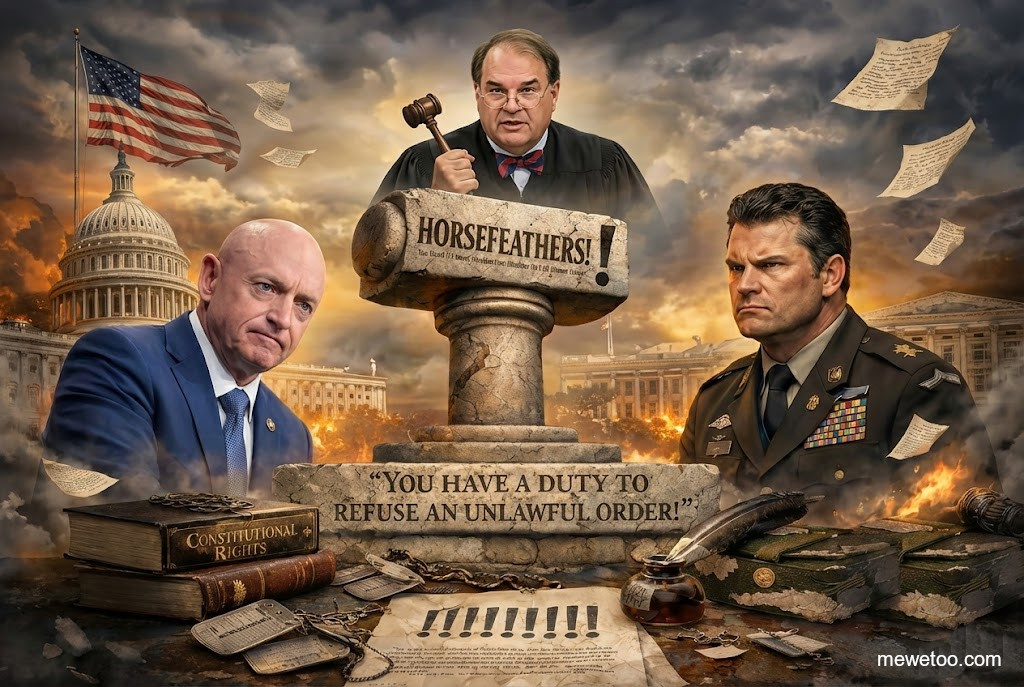
The legal battle between Defense Secretary Pete Hegseth and Senator Mark Kelly reached a constitutional boiling point this week. The stakes were significant: executive authority, military discipline, and the First Amendment rights of a retired service member.
But one of the most revealing details in Judge Richard Leon’s ruling wasn’t buried in constitutional doctrine.
It was in the punctuation.
Judge Leon issued a 29-page opinion blocking Hegseth’s attempt to demote Kelly and strip his military pension. No indictment for you. The judge didn’t just rule against the government – he essentially shut the door on them at the very first step – an open-shut case, without the case even being allowed to open.
Hegseth’s attack followed Kelly’s appearance in a public video alongside other former military officials and public figures, where he reiterated a long-standing principle of military law: service members have a duty to refuse unlawful orders.
The Defense Department responded with punitive action.
The court responded with emphasis.
“Horsefeathers!”
Judicial opinions are typically measured documents. Their authority comes from restraint – from careful phrasing, citation, and precedent.
This one was different.
Judge Leon used 15 exclamation points throughout the opinion.
At one point, rejecting the government’s justification outright, he wrote a single word:
“Horsefeathers!”
He went further. He warned that the court would not be complicit in narrowing constitutional protections. He quoted Bob Dylan – “You don’t need a weatherman to know which way the wind blows!” – underscoring what he viewed as the obviousness of the First Amendment violation.
The punctuation was not ornamental. It was declarative.
In the judge’s view, this was not a close call. It was a constitutional boundary.
FYI: It’s Set in Stone
It is worth noting that what Senator Kelly said isn’t a radical or “seditious” idea. It is literally what we teach our leaders. As Lawrence O’Donnell recently pointed out on MS NOW, if you walk through the plaza at the U.S. Naval Academy in Annapolis or past the monuments at West Point, you aren’t just looking at history; you’re looking at instructions.
There are signs and plaques in the very places where our officers train that state this exact principle: “You have a duty to refuse an unlawful order.”
Cadets and midshipmen pass these words every day. They are told from day one that their oath is to the Constitution, not to a person. Judge Leon wasn’t being “unprofessional” by using exclamation points; he was reflecting the intensity of a rule that is so fundamental it is literally set in stone.
The Fox News Flip-Flop
The irony here is thick enough to choke on. Before he was the Secretary of Defense – officially renamed the “Secretary of War” by Trump’s executive order – Pete Hegseth was a Fox News personality. And back then? He said the exact same thing. He once told his viewers it was “standard” and correct for the military to refuse unlawful orders from a Commander-in-Chief.
But now that he’s in the Cabinet, the “warrior” has become President Trump’s rubber stamp. Hegseth didn’t just try to remove Kelly’s pension; he threatened him with criminal prosecution and jail time. He’s traded his ethics and his integrity for a seat at the table, acting as an enforcer for an administration that views the Constitution as a suggestion. It’s a total betrayal of the very values he once sold to his viewers.
Rules for Ordinary Moments
Serious writing – whether in a legal manual or a developer’s style guide – rarely leans on exclamation points. The assumption is that restraint equals credibility. We are coached by Google and Apple to flatten our voice into a gray, optimized paste so that a bot can categorize us more easily.
But rules are built for ordinary moments. Judge Leon’s ruling suggests this was not one.
When executive authority is used to punish speech, neutral phrasing can soften what a court sees as sharp overreach. In this case, the emphasis signaled certainty. It conveyed that the actions of the Defense Department “trampled on Senator Kelly’s First Amendment freedoms and threatened the constitutional liberties of millions of military retirees.”
Language Carries Weight
We’ve spent so much time trying to please the machine – optimizing our titles and neutering our descriptions – but we can’t forget how to speak with conviction.
Courts are careful with words because words define limits. When a judge departs from the usual calm cadence of legal writing, it is rarely accidental. A period closes a thought, but an exclamation point signals that the thought carries force. In this ruling, Judge Leon left little doubt about how he viewed the stakes.
Sometimes, staying “professional” means refusing to be quiet. Sometimes, a period is just a shrug. And as this case proves, sometimes you just need the exclamation point!
Related Me We Too posts:
Pete Hegseth is Trump’s rubber stamp.
The people who work for President Trump in his second term are like a rubber stamp
I dont know how we are going to kick out corruption.
Fox News and their whatabout-isms drives me mad
Freedom of speech is not free if it costs you your career. #Joe Crain