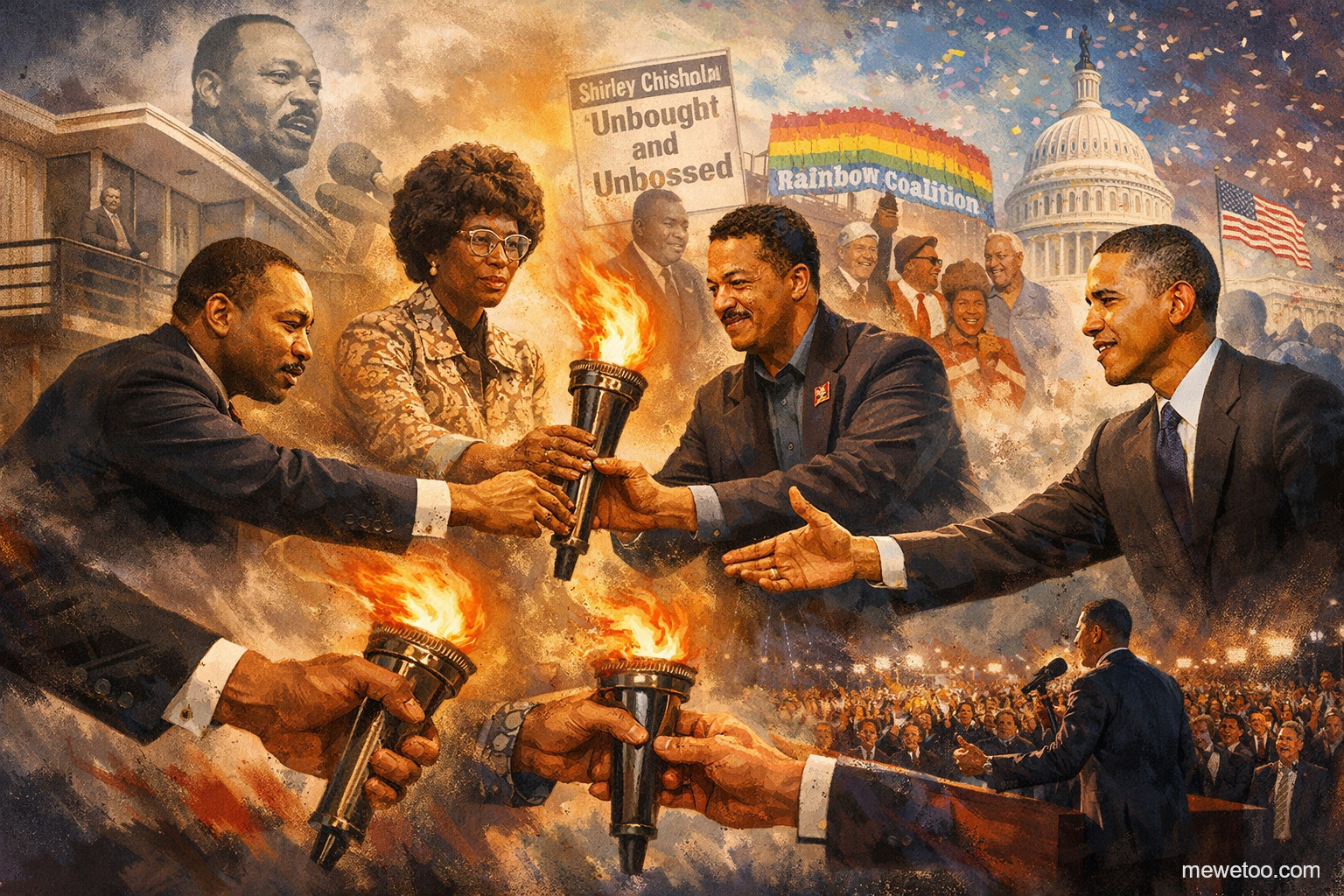
When we talk about the history of the American presidency, we often focus on the winners – the names etched into the granite of the White House. But sometimes, the person who doesn’t win the office is the one who actually changes the room.
Rev. Jesse Jackson didn’t just run for president; he broke the door down so an entire generation could walk through it.
From the Balcony in Memphis
To understand Jesse Jackson, you have to go back to the shadow of a tragedy. Long before the world stage, he was a young, firebrand lieutenant for Dr. Martin Luther King Jr. Jackson was a key leader in the Southern Christian Leadership Conference (SCLC) and was hand-picked by Dr. King to lead “Operation Breadbasket” in Chicago.
Jackson wasn’t just a staffer; he was in the inner circle. On April 4, 1968, he was standing in the parking lot of the Lorraine Motel in Memphis, looking up at the balcony, when the shot rang out that took Dr. King’s life. In the heartbreaking aftermath, Jackson appeared on national television still wearing a shirt stained with his mentor’s blood. It was a moment of passing the torch under the most horrific circumstances imaginable. He took the “Poor People’s Campaign” Dr. King had been planning and helped see it through, proving that while the dreamer was gone, the dream was still alive.
The Power of the Purse: Boycotts and Protests
Jackson knew that moral arguments weren’t always enough – you had to use economic leverage. Through Operation Breadbasket and later Operation PUSH, he organized massive “selective patronage” campaigns.
He didn’t just picket; he systematically targeted giant corporations (like A&P, Pepsi, and Coca-Cola) that did business in Black neighborhoods but refused to hire Black workers or use Black-owned suppliers. He’d tell the community: “If you can’t work there, don’t shop there.” These boycotts weren’t just about anger; they were about dignity. They forced major companies to sign “covenants” promising to hire Black managers and invest back into the communities that kept them in business.
“I Am Somebody”: The Anthem for the Invisible
One of the most enduring parts of Jackson’s legacy wasn’t found in a voting booth, but in school auditoriums and even on the set of Sesame Street. Through his PUSH-Excel program, he went on a crusade to reach youth who had been told by society that they were “less than.”
He popularized a powerful poem originally written by Rev. William Holmes Borders, Sr., turning those words into a thunderous, rhythmic “call-and-response” chant:
“I am somebody! I may be poor, but I am somebody! I may be on welfare, but I am somebody! I may be in jail, but I am somebody! I may have made mistakes, but I am somebody! I am God’s child!”
In 1972, he even took this message to Sesame Street, teaching children of all races to shout these words with pride. By including the line about being “in jail,” he was reaching out to kids who felt their lives were already over, telling them their inherent value remained intact. He famously told them, “You are not responsible for being down, but you are responsible for getting up.”
The Rainbow Coalition: A Quilt, Not a Song
You might be thinking of Kermit the Frog’s “Rainbow Connection,” but Jackson’s version was a gritty, real-world political machine. He founded the Rainbow Coalition based on a strategic alliance of “the rejected.”
The “Rainbow” represented a unification of different ethnic and economic groups – Black, White, Latino, Asian, and Indigenous – alongside family farmers and factory workers. He wanted to prove that a struggling white farmer in Iowa had more in common with a Black worker in Chicago than they did with the elites in Washington. He famously said:
“America is not a blanket – it is a quilt. Many patches, many pieces, many colors, many sizes, all woven and held together by a common thread.”
The Runs That Changed the Math
In 1984 and 1988, Jackson took the Rainbow alliance to the ballot box. While he never won the nomination, his 1988 run was a massive breakthrough that fundamentally shifted the Democratic Party. He finished second in the primaries, winning 13 state contests and nearly 7 million votes.
There was even a moment when the unthinkable seemed possible: after a landslide victory in the Michigan caucuses, Jackson became the frontrunner, a result that absolutely shocked the political establishment. It was during this high-water mark at the Democratic National Convention in Atlanta that he gave the world his most famous rallying cry. After an hour of soul-stirring rhetoric, he led the stadium in a thunderous chant that would define his legacy: “Keep hope alive!”
For Jackson, this wasn’t just a slogan; it was a strategy. He proved a Black man could build a competitive, multi-racial coalition, and in doing so, he built the political infrastructure that allowed Barack Obama to win in 2008.
That legacy came full circle on Election Night 2008 in Grant Park. As Obama took the stage to claim victory, the cameras panned to Jesse Jackson. He wasn’t cheering; he was weeping. Those were the tears of a man seeing a harvest he spent decades planting.
Standing on the Shoulders of a Giant
Jackson was always the first to say he didn’t start the fire. He famously gave credit to the woman who truly paved the way for a Black major-party candidacy: Shirley Chisholm.
In 1972, “Fighting Shirley” ran for president under the slogan “Unbought and Unbossed.” Jackson often noted that her courage provided the “psychological breakthrough” he needed to believe a run was possible. His own 1984 run helped push the Democratic party to finally break the glass ceiling by putting Geraldine Ferraro on the national ticket that same year.
Stumbles on the Path: Accountability and Growth
Legacy is rarely a straight line, and Jackson’s was no exception. In 1984, he faced a self-inflicted crisis when he was caught using a derogatory slur toward the Jewish community. The remark felt like a deep betrayal to many, especially given the sacred history of the two communities. From the founding of the NAACP to the iconic images of Rabbi Abraham Joshua Heschel marching hand-in-hand with Dr. King in Selma, the Black and Jewish struggle for justice had always been intertwined.
Jackson, a student of that history, knew he had failed the “Rainbow” he was trying to build. He didn’t hide from the mistake; he went before a synagogue and the national convention to offer a profound apology. He called his words a “mistake of the heart” and asked for forgiveness, acknowledging that building a “quilt” of many colors requires constant care, even from its own architects.
Later, in 2001, his moral leadership was tested again when he admitted to an extramarital affair that resulted in a daughter. He briefly stepped back from the public eye to reconcile with his family. These moments didn’t erase his work, but they humanized him, proving that even the most vocal advocates for justice must grapple with their own need for redemption. He often told others, “I may have made mistakes, but I am somebody,” and in these moments, he had to live those words himself.
The Pastor to the President
Jackson’s influence didn’t just live on the campaign trail; it reached into the most private rooms of the White House. During the height of the Monica Lewinsky scandal in 1998, when President Bill Clinton was at his most vulnerable, it was Jesse Jackson he called.
Jackson didn’t go to the White House as a political advisor, but as a minister. He provided pastoral counseling to the Clinton family, helping them navigate the personal fallout of the impeachment crisis. His loyalty and counsel during that “tough time” cemented a deep bond between the two men. In 2000, President Clinton recognized Jackson’s lifetime of service by awarding him the Presidential Medal of Freedom, the nation’s highest civilian honor.
A Global Peacemaker
Jackson’s work also went into the “lion’s den” to bring people home:
- Syria (1983): Negotiated the release of captured U.S. Navy pilot Robert Goodman.
- Cuba (1984): Secured the release of 22 Americans and 26 political prisoners from Fidel Castro.
- Iraq (1990): Convinced Saddam Hussein to release dozens of “human shields” held during the Gulf crisis.
Keeping the Hope Alive: The Work That Remains
Jesse Jackson’s journey from a blood-stained balcony in Memphis to a tear-filled park in Chicago wasn’t just about making history; it was about making a roadmap. “Keep Hope Alive” isn’t a passive wish – it’s a demand for action.
The “quilt” he spoke of is still being stitched together. Today, his legacy lives on every time a young person realizes they are “Somebody,” every time a worker stands up for a fair wage, and every time a new voter registers to have their voice heard. The infrastructure he built – that fusion of civil rights, economic justice, and international peace – is now the standard for how we create change.
As the baton passes to a new generation of leaders, the mission remains the same: to find the “rejected” and bring them into the center of the conversation. Rev. Jackson proved that you don’t need the keys to the White House to change the locks on the doors of opportunity. He showed us that while progress is often slow and painful, it is inevitable if we refuse to stay down. The harvest he planted is still growing, and it’s up to us to keep the field.
Tributes to a Trailblazer
Upon his passing, the leaders who walked through the doors he helped open shared their reflections:
- Barack Obama: “Jesse Jackson helped change the face of American politics. He wasn’t just a candidate; he was a bridge. He made me believe a journey like mine was possible.”
- Bill Clinton: “Jesse Jackson’s life was a testament to the power of persistence. He spent his life making sure the ‘least of these’ had a seat at the table. He was a lion of justice.”
- Michelle Obama: “He taught us that we are ‘Somebody.’ He took the baton from Dr. King and ran his leg of the race with a courage that gave the rest of us the strength to join in.”
Related Me We Too posts:
It’s a non-violent protest against racial injustice and police brutality – not a sign of disrespect.
I find it hard to believe that racism will ever cease. It’s unfortunate but also the reality.
I always think of myself just sitting in the same vehicle with Obama.
I wish obama would become president again
I think that Michelle Obama should run for office.
Feels like Trump would love to ruin Obama’s legacy of the Affordable Care Act
I didn’t think Trump would apologize for posting the racist meme video of the Obamas (and he didn’t)
Kamala Harris would have been an awesome President.
I think double rainbows are more amazing than artificial intelligence.