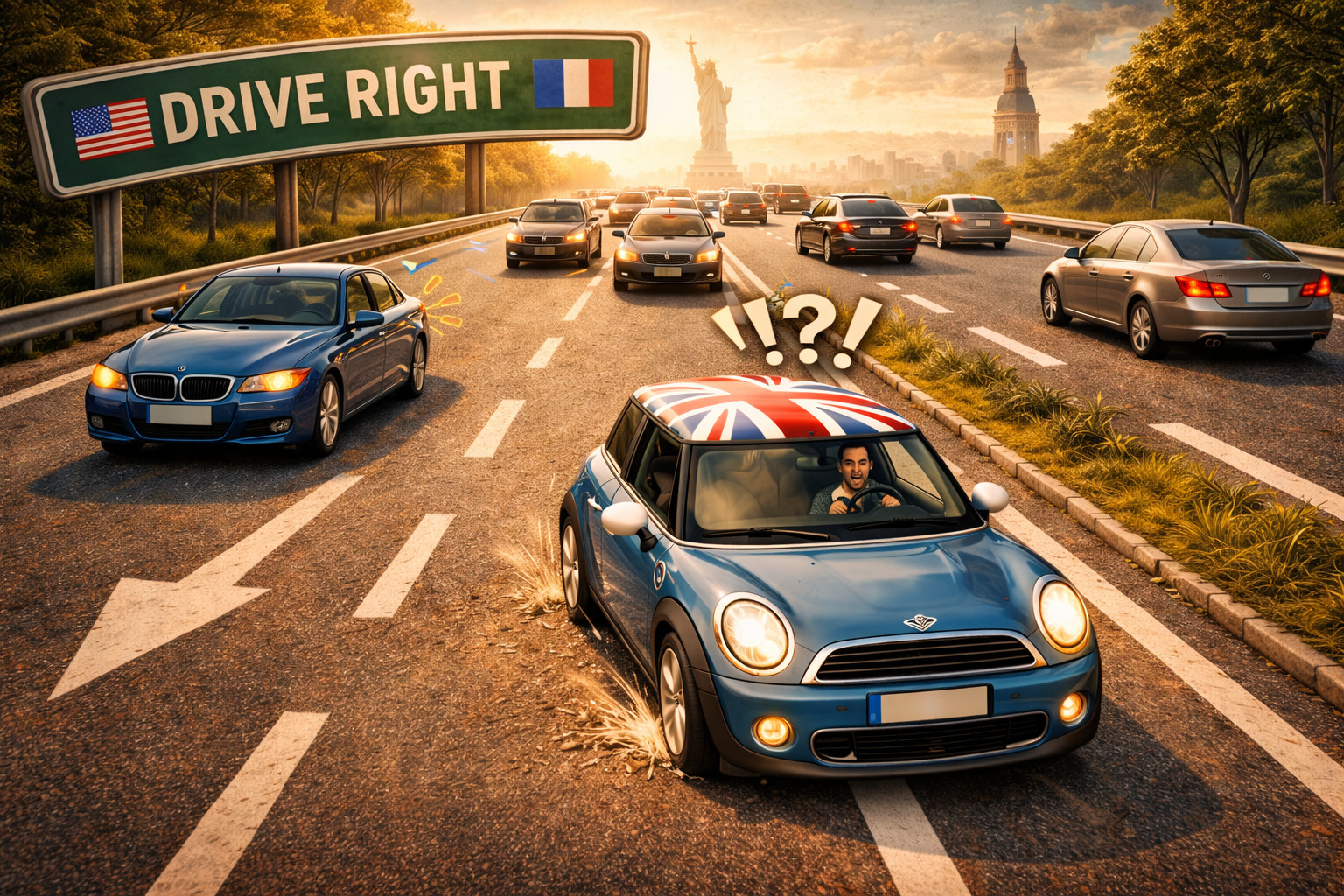
If you’ve ever landed in the UK, Australia, or Japan and felt that brief moment of panic watching cars come at you “the wrong way,” you’re not alone.
But here’s the part that surprises people: the United States and France both drive on the right – and that’s not a coincidence. In fact, their shared history is the reason about 70% of the world does, too.
It all started before cars existed
Long before steering wheels and traffic lights, people traveled on horses. Since roughly 90% of humans are right-handed, it created a very specific “survival” logic for the road:
- You mounted your horse from the left (so your sword, worn on your left hip, wouldn’t bang into the horse).
- You kept to the left side of the path so your right arm – your weapon hand – was between you and oncoming strangers.
- The Left-Handed Struggle: If you were a left-handed knight, the medieval road was a much more stressful place. You essentially had to adapt to a right-handed world or stay off the trails. As always, it does help to be ambidextrous.
For centuries, left-side travel was the global “normal” purely for self-defense.
Then France flipped the script
During the French Revolution, the road became a battlefield for social class. Traditionally, aristocrats paraded on the left in their carriages, forcing the peasants into the dusty margins on the right.
When the Revolution began, the elite realized that staying on the left made them an easy target for the mob. To blend in and show solidarity with the “common man,” everyone moved to the right side of the road. It was a physical act of political survival.
When Napoleon rose to power, he turned this revolutionary habit into law. Anywhere French influence spread – from the Netherlands to Poland – right-side driving followed.
The U.S. followed France, not Britain
America could have easily copied Britain’s left-side system. Instead, it leaned hard into its own identity and practical needs.
British wagons were small and driven from a seat. But American freight wagons, like the massive Conestogas, were giants. The driver typically rode the rear-left horse so his dominant right hand could better control the rest of the team.
Because the driver was positioned on the left side of his horses, he had to pull to the right side of the road to get a clear view of the wheels of the wagon passing him in the opposite direction. By the time the first cars arrived, this “anti-British” habit was already a core part of American culture.
Why the UK (and others) stayed left
Britain was an island, so it was never forced to follow Napoleon’s trend. It stayed on the left and exported that habit to its colonies – which is why the UK, Australia, India, and South Africa still drive on the left today.
Japan is the interesting outlier. They were never a British colony, but they hired British engineers to build their first national railway in the 1800s. Since the trains were designed for the left, the roads eventually followed suit. It wasn’t about better engineering; it was simply about who influenced the blueprints first.
A tiny rule that reveals something bigger
What side of the road you drive on feels obvious – until you realize it’s not. It’s a leftover fingerprint of:
- Revolution (France)
- Empire (Britain)
- Rebellion (USA)
And who you chose to copy (or reject). It is one everyday habit, quietly telling a 200-year-old story every time you turn the key.
Related Me We Too posts:
I like switching off left/right when doing stuff
Sometimes I put the computer mouse on the right, sometimes on the left
I’m right-handed, but left-footed.
I’m left-handed and my child is left-handed as well.
I’m left-handed, which is Latin for sinister… or, something like that.
The nice thing about driving is being able to get to places
Locally, my group of friends have each other’s backs and drive each other when needed.
Four wheel drives and older model vehicles make me happy
I dislike and try to avoid driving beside big rig trucks, especially on the freeway.
and behind trucks with a heavy load
I’m scared of driving past big trucks. I watch too much TV lol
I time it to pass by the big trucks asap – better not to be in its driving path, makes sense!
I will not ride in a self driving car, THANKS!
I think self driven cars are crazy
I think that all cars Should be fully self-driving.
Sitting in a Tesla doesn’t necessarily mean driving it 😉
I don’t drink and drive. It is crazy unsafe.
I don’t understand how people can text and drive, I’m too anxious for that.
I don’t text and drive. It’s crazy unsafe.
Beamers are a bad choice to drive.
Driving semi trucks is not as simple as it looks
I tell people I can drive, but I can’t
I’m learning to drive this year
I can only drive an automatic.
If you can drive in India, you can drive anywhere in the world.
Public transportation drives me crazy.
Traveling by trains sometimes is fun
I think the Amtrak trains are very comfortable
Today I traveled by train I was not comfortable.
I really enjoy taking the train. It’s such a calm experience.