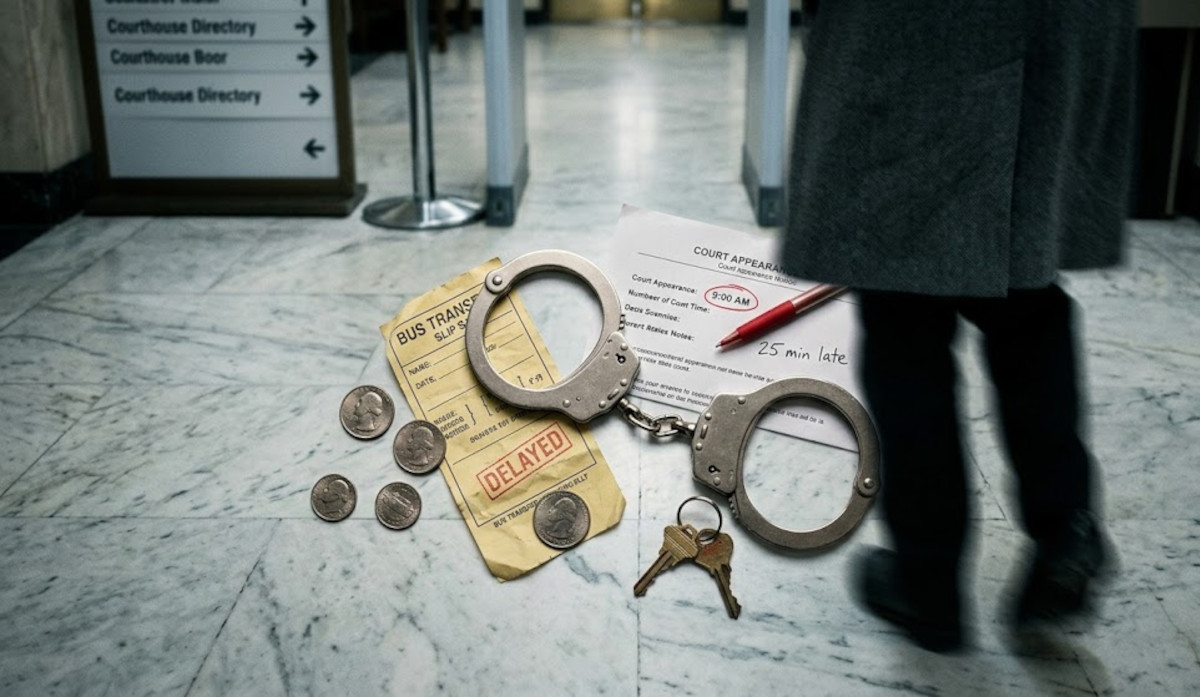
Imagine losing your job, your apartment, and your children – not because a jury found you guilty of a crime, but because you didn’t have twelve quarters in your pocket on a Tuesday morning.
When Emily Galvin-Almanza joined Lawrence O’Donnell on The Last Word (on MS NOW) and the Today Show recently, she stripped away the Hollywood glamour of the courtroom. In her new book, The Price of Mercy: Unfair Trials, a Violent System and a Public Defender’s Search for Justice in America (2026), Galvin-Almanza argues that we haven’t built a “hall of justice”; we’ve built a gauntlet for the poor where freedom is a product most can’t afford.
The “Lucky” Defendant
Galvin-Almanza opens her book with a powerful admission: she was once the person in the handcuffs. Arrested at 16, she describes herself as a “troubled” teenager who got a second chance because she had two things her future clients wouldn’t: white privilege and a judge who chose to see her potential instead of her “threat.”
The Bus Pass Trap
In the book, Galvin-Almanza introduces us to Dante, a young father working a minimum-wage job. He was arrested for a minor offense and released, but his court date was set for 9:00 AM across town. Dante didn’t have a car. On the morning of his hearing, his local bus route was delayed by 20 minutes.
By the time Dante walked into the courtroom at 9:25 AM, the judge had already issued a “bench warrant.” Dante was handcuffed in front of the other defendants. Because he now had a “Failure to Appear” on his record, his bail was hiked to an amount he couldn’t pay. He spent two weeks in jail. In those fourteen days, he missed enough shifts to get fired, and without a paycheck, he was evicted.
The system didn’t care why the bus was late; it only cared that Dante was poor enough to rely on it.
As Galvin-Almanza writes:
“We treat a missed bus like a moral failing. We are literally jailing people for being poor, and then we wonder why they can’t get their lives back on track.”
The Weaponization of Motherhood
The cruelty of the system often hides behind a “deal.” Galvin-Almanza shares the story of Ms. B, a mother charged with a crime she didn’t commit. Because she couldn’t afford bail, she was held in jail awaiting trial. The prosecutor offered a “ransom”: Plead guilty today, get “time served,” and go home to your kids tonight. Or, maintain your innocence, stay in jail for six months waiting for a trial, and risk losing your children to the foster care system forever.
Ms. B pleaded guilty to a crime she didn’t do, just so she could hold her children that evening.
“The prosecutor holds all the cards… For a parent with kids at home, that’s not a choice. It’s a ransom.”
The “Dog Hair” Conviction: Junk Science
Beyond the logistics, Galvin-Almanza exposes how the system uses “junk science” to secure convictions. She shares the chilling story of a man who spent decades in prison because forensic “experts” testified that a hair found at a crime scene was a “microscopic match” to him. Years later, DNA testing revealed the truth: the hair didn’t even belong to a human being. It was dog hair.
The “Hungry Judge” and the “Sports Fan”
If the logistics don’t break you, human biology might. Galvin-Almanza cites research showing that justice is often tied to a judge’s lunch schedule. The “Hungry Judge” studies show that judges were significantly more likely to grant parole or lighter sentences right after lunch, while those appearing right before lunch – when the judge was hungry – faced harsher rulings.
She even notes that in certain jurisdictions, sentencing became measurably harsher if the judge’s favorite local sports team had lost the previous weekend. It’s a reminder that “blind justice” is often influenced by an empty stomach or a bad mood.
A New Blueprint: 9,000 Years of Freedom
Through her organization, Partners for Justice, Galvin-Almanza is proving it is actually cheaper to help people than to hurt them. By providing “bureaucracy doulas” – advocates who handle housing, jobs, and free Uber rides to court – her model has already eliminated nearly 9,000 years of potential incarceration.
The Bottom Line: Investing in Mercy
Emily Galvin-Almanza is the living proof of her own thesis. If a judge hadn’t looked past her handcuffs at age sixteen – if he hadn’t chosen to see a “troubled teen” with potential instead of a permanent “threat” – the 9,000 years of freedom reclaimed by Partners for Justice may not have existed. She may not have existed. Because one judge chose mercy over a jail cell, a public defender was born; because she was given a second chance, thousands of others now have theirs.
As she challenges us in The Price of Mercy:
“Our legal system is built on the idea that if we hurt people enough, they will somehow become ‘better.’ But you cannot torture someone into stability. You cannot jail someone into a job. Mercy isn’t a gift we give to the ‘deserving’—it’s a requirement for a safe society.”
It’s time we stop looking for justice in a jail cell and start looking for it in the basic human needs that keep our neighbors whole. When we stop punishing people for the “crime” of being poor, we don’t just fix a broken court—we unlock the potential of the very people the system tried to write off.
Related Me We Too posts:
The level of poverty in my country is getting higher. I wonder why.
Google maps knows nothing about the LA bus schedule.
Bikes can be really dangerous on busy city streets
Haven’t been on the bus in a while. It’s sort of relaxing.
I only road the bus freshman year to and from college
Catching the bus isn’t that bad
Traffic would be so much better if you took the bus a few times a week.
I want to work hard to be able to buy the car of my dreams
I wish I could go back to college and finish my degree but I’m too poor.