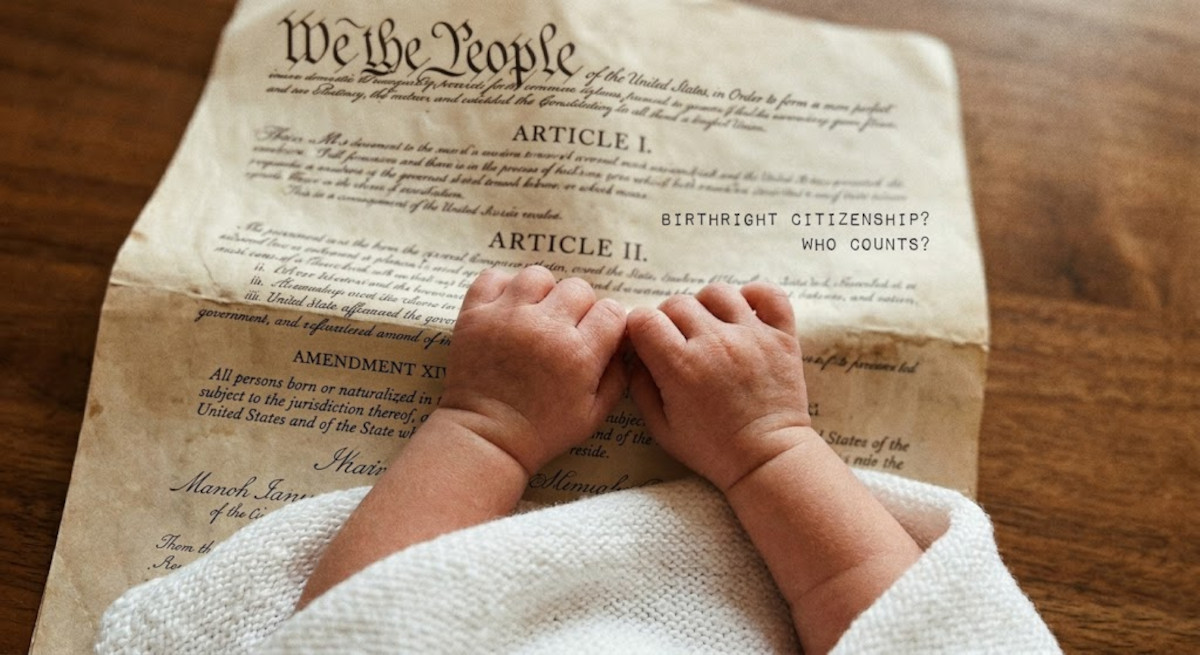
There is a sentence in the United States Constitution that is not a suggestion. It is not a “guideline.” It is not a tweet sent in the middle of the night to satisfy a base of supporters who believe the Law of the Land is whatever they want it to be on any given Tuesday.
It is the first sentence of the Fourteenth Amendment. And it says, with a clarity that has survived a Civil War, Reconstruction, and 158 years of American history:
“All persons born or naturalized in the United States, and subject to the jurisdiction thereof, are citizens of the United States and of the State wherein they reside.”
It is simple. It is absolute. And today, it is under an attempted constitutional erasure – an executive assault the likes of which this country has never seen.
The “Day One” Dictate
On January 20, 2025 – his first day back in the Oval Office – President Donald Trump signed an executive order. It wasn’t an order to fix the border or to streamline the bureaucracy. It was an order to rewrite the English language.
The order seeks to deny citizenship to babies born on American soil if their parents lack permanent legal status. It is a directive that tells the Social Security Administration and the State Department to look at a newborn baby in a hospital in El Paso or a clinic in Chicago and say, “Your birth certificate is a lie. The Constitution does not apply to you.”
This isn’t just a policy shift. It is a constitutional heist.
The Architecture of Exclusion
To understand why this is happening, you have to look past the dry legal briefs and listen to the man himself. This isn’t a neutral effort to “clarify” the law; it is the policy manifestation of a long-standing grievance against specific cultures.
This is the same man who stood in the Oval Office and wondered aloud why we couldn’t get more immigrants from Norway instead of what he called “shithole countries” in Africa and the Caribbean. This is the man who spent the 2024 campaign amplifying a debunked, xenophobic urban legend about Haitian immigrants eating pets in Ohio. He has spoken of “bad genes” and warned that immigrants are “poisoning the blood of our country” – language that feels less like a policy debate and more like a throwback to the darkest chapters of history.
The administration’s lawyers will tell the Supreme Court this is about “birth tourism” and “closing loopholes.” But we don’t have to guess at the motive. We have the quotes. We have the history. By casting certain groups as fundamentally “other,” he creates the moral clearance to argue that their children – born in our hospitals, breathing our air – are somehow not “truly” American.
He is targeting the very idea of a multi-ethnic democracy. When a President spends years warning that immigrants are “poisoning the blood of our country,” and then signs an order to strip their children of citizenship, he isn’t solving a legal technicality. He is attempting to codify a prejudice.
The Legal Ghost of 1898
The Trump administration, led by Solicitor General D. John Sauer – the same attorney who served as Trump’s lead criminal defense counsel and won the 2024 ‘presidential immunity’ case – argued this week before the Supreme Court in Trump v. Barbara that we have all been reading the 14th Amendment wrong for a century. They claim the phrase “subject to the jurisdiction thereof” only applies to people who owe “permanent allegiance” to the U.S. – effectively excluding the children of those on temporary visas or without legal status.
But there is a problem with that argument. A big one. It’s called history.
In 1898, the Supreme Court decided United States v. Wong Kim Ark. Wong Kim Ark was born in San Francisco to Chinese parents. The government tried to say he wasn’t a citizen because his parents were “subjects” of the Emperor of China. The Supreme Court – in a 6-2 ruling – told them they were wrong. They ruled that “jurisdiction” means exactly what it sounds like: if you are on our soil and subject to our laws, you are “subject to the jurisdiction.”
In doing so, the 1898 Court established what legal scholars call a ‘fixed, bright-line rule.’ It was a clear boundary intended to protect citizenship from the whims of politics. If you are born on our soil and subject to our laws, you are a citizen – a fact that no President has the power to ‘interpret’ away.
Donald Trump wants to reach back to 1898 and tear those pages out of the law books. He has argued that the 14th Amendment was merely a specific remedy for the era of slavery – a fix for a narrow moment in history that has no bearing on the children of immigrants today.
It is a chilling logic. He is attempting to revive the ghost of the Dred Scott decision, the 1857 ruling that infamously declared that Black people, whether enslaved or free, could never be American citizens because of their ancestry. When you strip away the legal briefs, the comparison is unmistakable:
- Dred Scott (1857): Citizenship is not a birthright; it is a privilege reserved for those of the “right” race and ancestry.
- Trump (2025/2026): Citizenship is not a birthright; it is a privilege reserved for those whose parents have the “right” legal status and allegiance.
The Supreme Court already rejected this logic in 1898. They confirmed then that the 14th Amendment wasn’t a temporary patch for one group; it was a permanent rejection of state-sponsored prejudice. It was designed to ensure that citizenship is a birthright for everyone born here, not a gift to be granted or withheld by a President based on who your parents are. By claiming the Amendment’s purpose has essentially “expired,” the administration is claiming the power to decide which parts of the Constitution still matter and which can be discarded.
The Defense of the ‘Bright Line’
Standing across from Sauer was Cecillia Wang, the Deputy Legal Director of the ACLU and a veteran Supreme Court litigator. Her argument was as simple as it was devastating: The 14th Amendment wasn’t written in pencil, to be erased by whichever President happens to be holding the eraser.
Wang didn’t just argue the law; she provided a history lesson that mirrored the modern rhetoric of ‘invaders’ and ‘trespassers.’ She reminded the Justices that the 14th Amendment was written following 20 years of unprecedented immigration from Ireland—a group the ‘Know-Nothing’ Party of the 1850s claimed was ‘unassimilable’ and ‘dangerous’ to the American character.
‘Even the Know-Nothings,’ Wang noted, ‘conceded the point the government is trying to erase today.’ She pointed out that while 19th-century nativists may have loathed Irish Catholic immigrants, they never questioned that the children born here were Americans. By attempting to strip citizenship from those the President now labels ‘invaders,’ she argued, the administration is seeking to be more exclusionary than the most infamous anti-immigrant movement in American history.
Wang reminded the Justices that birthright citizenship isn’t a policy preference that Congress or the President can “tweak” – it is a constitutional fact. To credit the government’s theory, she warned, would be to render “swaths of American laws senseless” and cast the citizenship of millions into a shadow of permanent uncertainty.
The Cost of a “New” Constitution
If this executive order is upheld by a Supreme Court that has already shown a willingness to ignore precedent, the America we know disappears.
- The Bureaucracy of Blood: Every single American parent would eventually have to prove not just where their child was born, but who they are. A birth certificate would no longer be enough.
- The Stateless Generation: We would be creating a permanent underclass – children born here, raised here, speaking our language, who have no country to call their own.
- The $1,600 “Baby Tax”: Estimates suggest parents could face up to $1,600 in legal and government fees just to prove their newborn is, in fact, an American.
Who Counts as an American?
Despite the rhetoric, we are not the “only country in the world” that does this. At least 30 other nations, including Canada and Mexico, recognize birthright citizenship. But more importantly, we are the United States of America. Our identity isn’t based on a bloodline or a monarch; it is based on a document.
When you begin to “tinker” with the definition of a citizen based on the status of their parents, you aren’t just attacking immigrants. You are attacking the very foundation of the American promise.
The Supreme Court finished listening to arguments today, April 1st. No joke – the Trump administration wants to cancel the Constitution. The Court will issue its ruling by July.
Between now and then, the question is no longer abstract. It is as concrete as a newborn in a hospital crib in El Paso or a clinic in Chicago.
The Court must decide: Does the 14th Amendment belong to the people, or can it be erased by the stroke of a President’s pen?
Who counts in this country, and who gets to decide?
The answer to those questions will define the next hundred years of the American experiment.
Related: Power, Language, and the Dehumanization of the “Other”
Related Me We Too polls:
Birthright Citizenship should stand obviously – it is the 14th Amendment in the U.S. Constitution
Trump’s executive order to cancel Birthright Citizenship is rooted in xenophobia and racism.
Proud to be kid of immigrants.
I think that the “born here to be President” law is offensive to immigrants