In politics, we are taught to watch a candidate’s mouth. But in 2026, that instinct is outdated. It is an antique. Because the real story of power is told through signals – through what is amplified, what is dismissed, and what is quietly, legally allowed.
As of April 2026, the honeymoon for New York’s first progressive socialist Mayor, Zohran Kwame Mamdani, has hit a wall of digital reality. We now know that his wife, Rama Duwaji, “liked” social media posts celebrating the October 7th attacks. We know she liked posts calling reports of sexual violence a “hoax.” This was documented in early March by Jewish Insider and The Free Press.
And it has reignited a debate Mamdani spent his entire 2025 campaign trying to bury:
At what point does political “dissent” cross the line into cheering the massacre?
The Shield
During the primary, Mamdani had the ultimate moral insurance policy: Senator Bernie Sanders.
For Sanders, this was a passing of the torch. He saw in Mamdani a mirror of his own 1981 upset in Burlington. But even a mentor has limits. In July 2025, Sanders – the son of a family wiped out in the Holocaust – gave Mamdani a direct, personal warning:
“You have to do a better job explaining that your criticism is not antisemitic… do not let yourself seem like you’re minimizing the fear Jews feel.”
Mamdani had heard this before. A year earlier, in June 2024, he stood before a synagogue and admitted that slogans like “Globalize the Intifada” were a “bridge too far.” He acknowledged that for Jewish New Yorkers, it sounds like “bus bombings in Haifa.” He promised then to “discourage” the term.
But if Mamdani thought his ‘bridge’ had reached the other side, he was mistaken. Over 600 rabbis, led by Rabbi Hirsch and Rabbi Elliot Cosgrove, moved to oppose him. To them, the ‘bridge’ was a temporary political detour. A detour Mamdani abandoned the moment he took the oath of office.
Sanders is no friend to the Netanyahu government. He has decried “mass starvation” in Gaza. But Sanders’s dissent is explicitly rooted in policy. Mamdani’s silence functions as permission. Sanders warned against minimizing fear; Mamdani has staffed his administration with those who amplify it. The “Grammar of Silence” has replaced the bridge Sanders tried to build.
Cleaning Up or Clearing Out?
Mamdani’s first act as Mayor was political theater dressed as governance. He signed a sweeping revocation of every executive order issued by Eric Adams after his September 2024 indictment. He framed it as “cleaning up corruption.”
But while the public heard “corruption,” the move quietly erased the city’s functional protections. It erased the IHRA Definition of Antisemitism – the standard used to identify when anti-Zionism crosses into hate speech. It erased the Anti-BDS Order – the rule prohibiting city agencies from using taxpayer dollars to reward companies that boycott Israel. And it erased Executive Order No. 61 – the physical security mandate. That was the directive that required the NYPD to establish “hard” security perimeters and buffer zones around houses of worship.
By revoking it on Day One, Mamdani removed the police mandate that kept protesters at a distance from synagogue entrances. He told the public he “didn’t use the language” of the radical street – but he dismantled the city frameworks that previously defined, and physically policed, such harassment.
The Selective Compass
Mayor Mamdani is capable of profound moral clarity. In March 2026, when a far-right group organized a “Stop the Islamic Takeover” protest outside Gracie Mansion, the Mayor was resolute. He called it “vile.” He called it “rooted in white supremacy.” He was right.
But leadership is about standing in that same light when your own base is the source of the darkness.
In January, when protesters outside a Queens synagogue chanted pro-Hamas slogans, Alexandria Ocasio-Cortez (AOC) immediately denounced it as “disgusting and antisemitic.”
Mamdani waited nearly twenty-four hours to offer a statement that was as clipped as it was hollow. He called the chants ‘wrong’ but refused to call them ‘antisemitic.’ He spoke of ‘both sides’ while one side reveled in the slaughter. It was a statement that sought to manage a PR crisis rather than confront a moral one.
When the City Council finally passed a new “Synagogue Buffer Zone” bill to replace the protections Mamdani revoked, the victory was mostly on paper. Critics pointed out the catch: while the original law mandated physical barriers, this new version was “watered down.” It merely requires the NYPD to “create a plan.” It contains no fixed distance. It contains no mandatory barriers. It is a suggestion, not a mandate. Even as the bill gained a veto-proof majority, Mamdani refused to take a position, citing “constitutional concerns.”
When the target is Islamophobia, the Mayor uses the sharpest tools. When the target is his Jewish constituents, he retreats into a “grammar of silence.”
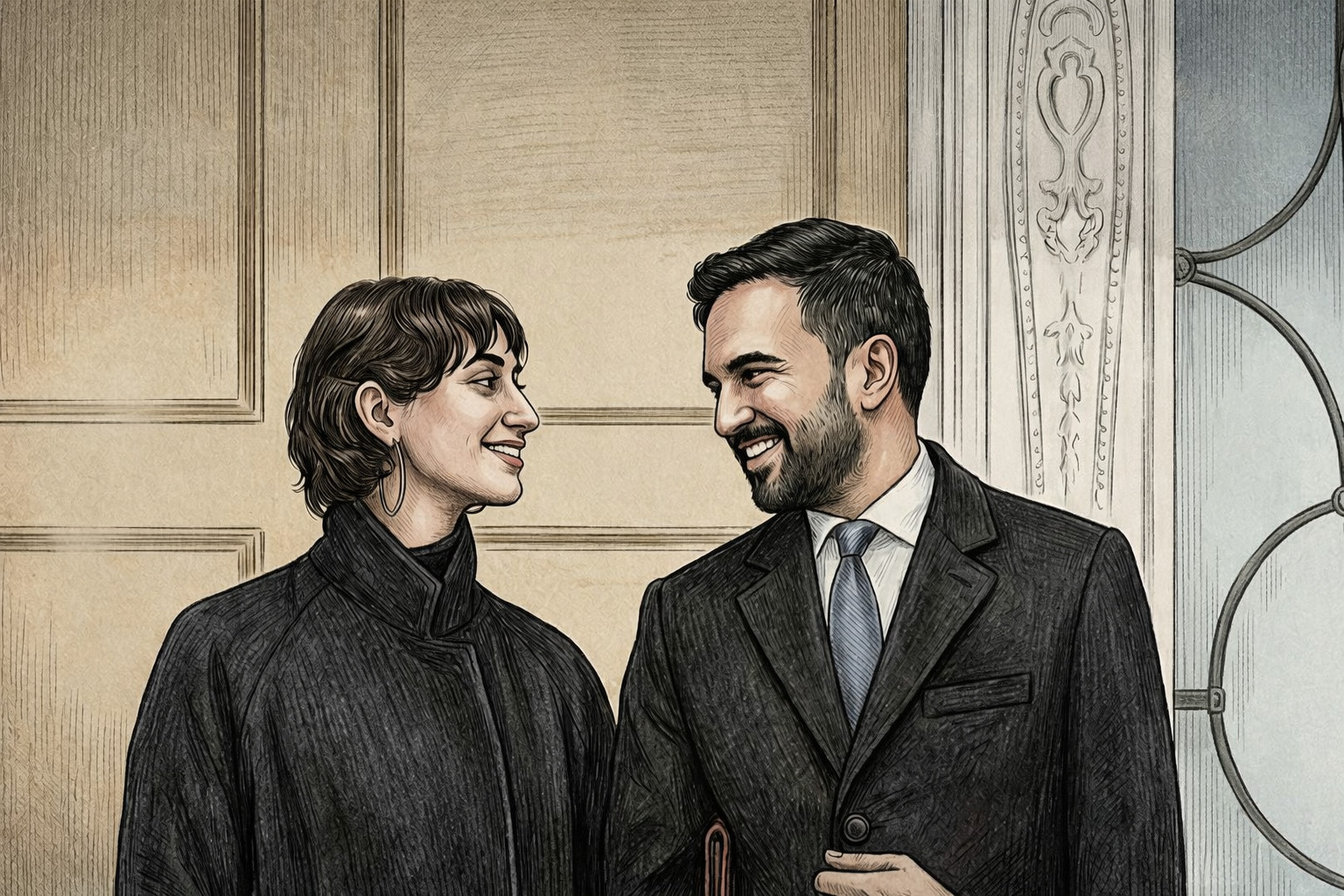
This silence extends from the steps of City Hall to the Mayor’s own dining table.
When confronted in March 2026 with his wife’s social media activity, Mayor Mamdani’s defense was immediate: “She is a private person.” But the label breaks under his own rhetoric. In his inaugural address, he called his wife his “anchor in private life.” You cannot claim your partner is the moral “anchor” of your world while claiming her public celebration of a massacre has zero connection to your administration.
This pattern is not new. During his campaign, he was forced to address his 2017 track “Salaam,” where he rapped: “My love to the Holy Land Five.” When critics pointed out they were convicted of funneling millions to Hamas, his team dismissed it as “artistic expression.” He later reframed the conviction as a “miscarriage of justice” – using the language of civil rights to shield a shout-out to terrorist financiers.
Freedom of Conscience
This is the “Mamdani Difference.” It is an administration that demands immediate resignation for the “classic” tropes of the past – like Catherine Almonte Da Costa, the Director of Appointments who was forced out before she even started for decade-old tweets about “money hungry Jews.”
Mamdani called those words “unacceptable.” He accepted her resignation in hours. But for those whose rhetoric targets the present – figures like Senior Advisor Sarah Abdul-Ghani, who has equated Zionism to Nazism – the rules are different.
The roots of this shift trace back to his transition team, which included Nerdeen Kiswani, the founder of Within Our Lifetime. While AOC and Sanders have both condemned that group for antisemitic tropes, Mayor Mamdani has chosen to erase that line. Standing alongside them is Chief Counsel Ramzi Kassem, the man now drafting the city’s legal policies – the functional blueprint for the Mayor’s “Day One” rollbacks.
When asked why the standards apply to some and not others, the Mayor has his answer ready. He has refused to issue discipline to his current staff, citing the “freedom of conscience” of his team.
For the old tropes, there is an exit door.
For the new ones, there is a seat at the table.
The Verdict
Old politics was about what leaders said; new politics is about what they allow.
On the material conditions of New York, Mamdani is playing a high-stakes game. And he is winning. He secured 2-K childcare. He pitched a $21 billion federal housing plan. He stood in the Oval Office and handed President Donald Trump a mock headline: “Trump to City: Let’s Build.” It was a masterstroke of flattery. It worked. It secured support for 12,000 new affordable homes at Sunnyside Yard.
Following that same February meeting, Mamdani successfully lobbied for the release of Elaina (Ellie) Aghayeva, a detained Columbia University student. He proved he has a direct line to the White House that his predecessors lacked.
On March 29, Bernie Sanders was in the Bronx, rallying for a “Tax the Rich” agenda. In a telling move, the Mayor did not attend. He left Sanders to act as the movement’s voice. It was a masterclass in tactical absence. Mamdani gained the benefit of Sanders’s moral authority while avoiding the protests happening outside. He let a moral giant absorb the heat while he remained safe in City Hall.
The real failure here isn’t on the part of the mentor. It’s that Mamdani has turned this tangible progress on childcare and housing into an “economic shield.” He is using the bricks of new housing to justify a local policy of avoidance.
New York is operating under a new grammar. In this administration, silence is not an absence of leadership.
It is a choice.
And that silence is never neutral.
It’s policy.
Senator Bernie Sanders: “Hate and discrimination of any kind is beyond acceptable and has no place in our society… It should not be a controversial statement to say that antisemitism is horrific… and must not be tolerated any place in our country.”
Related: The Blueprint for a Registry: How the “Penn List” is a Threat to Every Minority in America
Related Me We Too polls:
No to Zohran Mamdani for NY mayor.
Hate speech should be condemned.
Jen Psaki doesn’t get it. #noMamdani
I’m an Independent like Bernie Sanders.
I agree with Bernie Sanders and the 5% Billionaire Tax.
Bernie Sanders would have been an awesome president
Bernie Sanders is for the people
Politicians always are the same .
I dont know how we are going to kick out corruption.
Problem I, people cant get over corruption.
I can’t really discern between socialism and communism
I think liberal policies are more open and accepting of others, and more helping/caring too
I go for the candidates with liberal ideas
I vote in every election even when not knowing candidates