

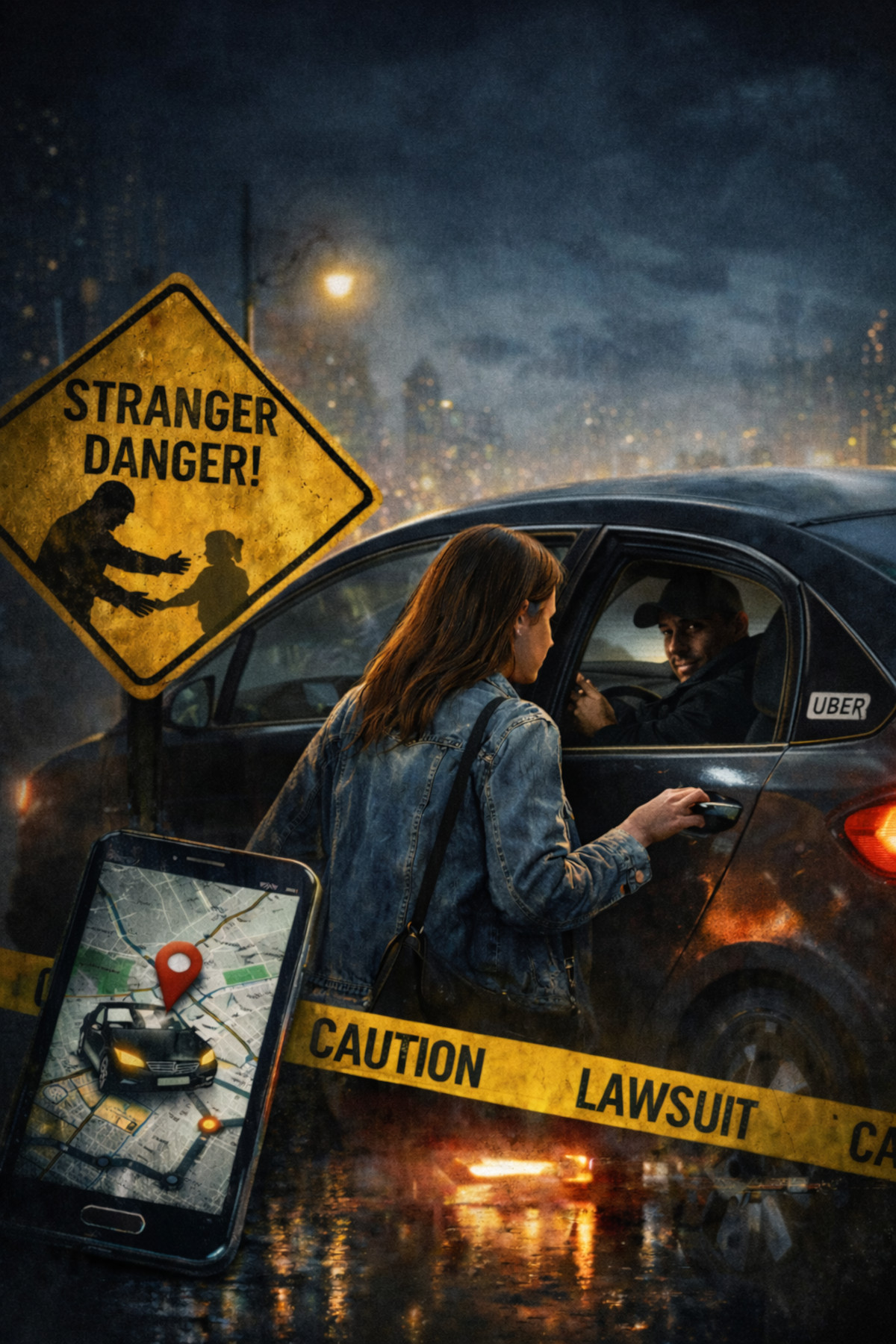
For decades, one rule was drilled into everyone’s head: don’t get into a stranger’s car.
Not as a suggestion. As a survival instinct.
Then, almost overnight, an app showed up and said: Actually, go ahead – it’s fine now.
Not because strangers stopped being strangers, but because there was a logo on the windshield and a credit card on file.
If you really stop and think about it, it’s kind of wild that this ever felt normal.
You’re alone.
It’s often late.
You’re climbing into a car owned by someone you’ve never met, going somewhere they control, trusting that an app did enough vetting to make this safe.
And despite how aggressively ride-share companies marketed the idea of safety, that unease never really went away. It was just buried under convenience.
Now, it’s coming back to the surface.
When “Safety” Becomes a Legal Claim
On February 5, 2026, a federal jury ordered Uber to pay $8.5 million in damages to a woman who was raped by her Uber driver. The lawsuit was filed in 2023, following the incident that occurred in November of that year. The key issue wasn’t just what the driver did – it was Uber’s responsibility.
For years, Uber has advertised itself as a safer alternative to traditional rides: background checks, tracking, ratings, accountability. That image mattered. It’s what convinced millions of people to override instincts that had existed for generations.
The jury decided that Uber can’t promote safety as a core feature and then wash its hands when that promise fails.
That decision matters because this wasn’t a one-off case.
More than 3,000 similar lawsuits are reportedly pending. This trial was a test case – a preview of what could come next.
And the uncomfortable truth is this: those 3,000 cases aren’t numbers. They represent thousands of women who say something went wrong in the back seat of a car they were told was safe.
The Gig Economy’s Big Blind Spot
Uber’s entire model depends on a convenient legal fiction: drivers are independent contractors, not employees. That framing fueled massive growth, lower costs, and rapid expansion.
Here’s the reality:
When you’re locked inside a moving car, the distinction between “contractor” and “employee” doesn’t matter to the person in the back seat.
From the rider’s perspective, the driver is Uber.
That’s the contradiction courts are now being asked to resolve. If a company profits from putting strangers together in isolated environments – and markets that experience as safe – how much responsibility does it actually bear?
The Illusion of Control
Ratings, GPS tracking, panic buttons – these features look reassuring, but they don’t prevent harm in real time. They mostly document what happened after the fact.
Uber has introduced a women‑preference option in many U.S. cities in July 2025. Female riders can request a female driver, either on demand or by setting a preference in the app to prioritize women drivers — though if no female driver is available at that moment, the ride may still be matched with a male driver. Female drivers, on the other hand, can opt in to only accept rides from women, ensuring they never get matched with male riders. The feature was first piloted in cities like Los Angeles, San Francisco, and Detroit, and has since expanded to more than two dozen U.S. markets, including Baltimore, Chicago, Dallas‑Fort Worth, Denver, Houston, Nashville, Orlando, Phoenix, Sacramento, Salt Lake City, San Diego, and Tampa. While it aims to address safety concerns and restore rider trust, it’s not universally available and doesn’t fully eliminate risk – a reminder that technology can reduce – but never completely remove – danger.
And that’s the part people are struggling with now:
Was the promise of safety ever real, or was it just a layer of interface design that made risk easier to accept?
We didn’t suddenly stop fearing strangers. We were trained to suppress that fear because the app told us to.
As is clear from Me We Too polls, some love Uber, and so never bought into it. Some people kept listening to that old instinct – the one that said getting into a stranger’s car was never supposed to feel normal.
Is This the Beginning of the End?
Uber probably won’t disappear tomorrow. Companies this large rarely do.
The company has money, lawyers, and a history of influencing the laws that determine how it operates.
Tobacco giants survived massive settlements. Opioid manufacturers did too. Automakers survived deadly defect scandals. Oil companies endured environmental disasters. When corporations face multi-billion-dollar liability, they don’t usually collapse. They restructure. They settle. They reprice. They rebrand.
But they are never the same.
If even a fraction of the 3,000 pending cases result in substantial payouts, Uber could be staring at billions in exposure. And verdicts are only part of the equation.
What could reshape the company even more than jury awards?
- Regulatory crackdowns
- Pressure to classify drivers differently
- Rising insurance costs
- Investor unease
- Slow erosion of public trust
Uber’s entire model was built on the idea that it’s a neutral tech platform connecting riders and independent contractors.
That long-standing unquestioned assumption is cracking. Courts are starting to ask harder questions. So are users.
And once people start re-examining the basic premise – “Wait… why did we ever think this was safe?” – it’s hard to unsee it.
Maybe this isn’t the end of Uber. But it might be the end of pretending that convenience cancels out risk.
And it might be the moment we admit that some instincts existed for a reason.
Related Me We Too posts:
I just had the worst uber like what the f***
I don’t plan on ever taking Uber or any other “rideshare”
I would rather go with a taxi vs Uber, Lyft, or other “rideshares”
I think taxis are a lot safer than a rideshare like Uber or Lyft.
I love to go out and meet random strangers but only if they seem safe and friendly.
I want a new car to do rideshare but frankly i like older cars better
I like to say random things to strangers, see what they say back, their reaction







The Checklist
I check the backseat before I get in. I don’t wear both headphones so I can hear your feet. I send my location to a friend “just in case.” I look for the light and avoid the shortcuts. I hold my keys between my fingers like a weapon. I check the time of night before I walk out the door.
I wonder if you know that I am doing all of this just to get to my front door. While you are just… walking home.
🚨 The End of Uber?
We were told never to get in a stranger’s car – yet thousands trusted an app.
A jury just hit Uber with $8.5 M in a sexual assault case. 3,000+ similar lawsuits are pending. Convenience didn’t remove risk – it just buried instincts.
Read more 👉 azipurl.app/uber