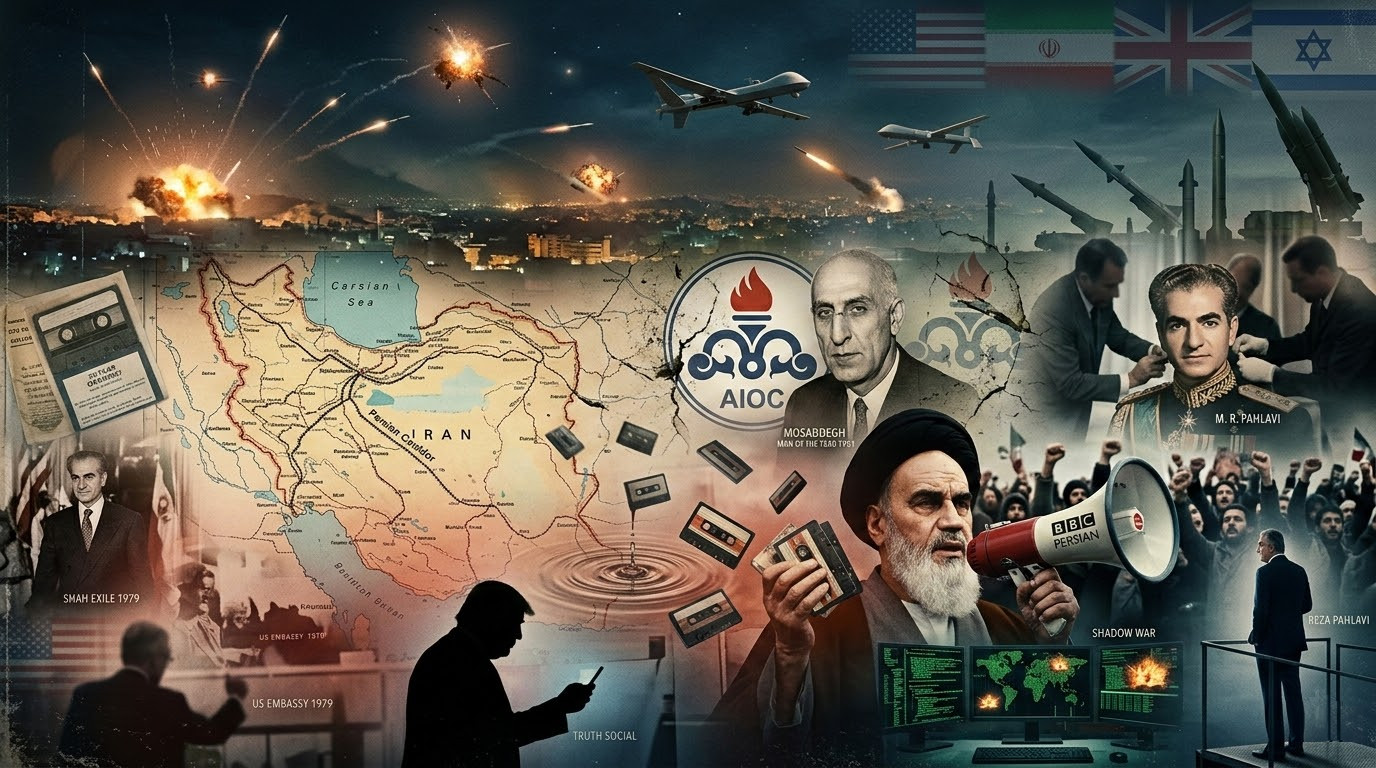
We are nearly a week into Operation Epic Fury.
Bombs and missiles are now crisscrossing the region. Confirmed strikes and retaliations have taken place in Iran, Israel, Lebanon, Kuwait, the United Arab Emirates, Saudi Arabia, Bahrain, Qatar, Iraq, and Jordan. The conflict has already spilled beyond the Middle East: Iranian drones have struck the British sovereign base at Akrotiri in Cyprus, projectiles have reportedly landed as far away as Azerbaijan and Oman, and naval engagements have pushed fighting into the Indian Ocean near Sri Lanka.
Meanwhile, Syria and Yemen – through Houthi retaliation – are seeing escalating strikes, and Turkey and Afghanistan are already reporting airspace violations and trade disruptions.
The scale is staggering.
A decade ago, the idea of World War III felt almost absurd – something belonging to history books rather than the modern world. Yet the current cascade of regional escalation shows exactly how such a scenario could unfold.
While Congress continues to label the conflict an “operation,” the reality on the ground increasingly resembles something far larger: a widening war with mounting casualties.
And that raises the inevitable question: Who started it?
Critics point to the U.S., noting that the February 28 strikes were ordered by President Trump. Supporters counter that Trump didn’t start a war – he is merely ending a 47-year war begun by Iran’s Islamic regime in 1979.
But both narratives overlook something crucial.
To understand how this conflict began, you have to look further back – much further back.
The Original Sin: 1941–1953
The roots of today’s crisis stretch back more than seven decades.
During World War II, after Nazi Germany invaded the Soviet Union, Iran’s railroads were vital to supplying the Soviet Union with needed weapons, vehicles, and food from the Allies (Britain and the U.S.) to survive. The safest, most efficient route to deliver these millions of tons of supplies was through Iran – specifically using the newly built Trans-Iranian Railway, the “Persian Corridor.”
Reza Shah declared neutrality and refused to kick out German engineers working in Iran. In response, Britain and the Soviet Union launched a full-scale invasion in 1941 and quickly advanced toward the capital. They simply could not risk losing control of that critical railroad to Nazi sympathizers. They gave him a brutal choice: abdicate immediately to save the throne for his son, or stay and watch the monarchy be abolished by force. To save his dynasty, he stepped down. The Allies coerced the King into a lonely, forced exile – first to the island of Mauritius for six months and finally to Johannesburg, South Africa, where he died three years later, broken and alone.
The Allies got what they wanted. In his place, they installed his inexperienced Western-educated 21-year-old son, Mohammad Reza Pahlavi, whom they believed would be a more compliant puppet. For more than a decade, Iran functioned as a fragile semi-democracy. Parliament held real power, and the country’s most popular political figure was a nationalist leader named Mohammad Mosaddegh.
Mosaddegh became an international symbol of anti-colonial resistance when he nationalized Iran’s oil industry. The move stripped control from British companies that had been pocketing the vast majority of the profits to fuel the Royal Navy and rebuild Britain’s economy after WWII. His popularity was so immense that Time magazine named him Man of the Year in 1951, calling him the “Iranian George Washington.”
But his defiance triggered a geopolitical crisis.
Britain launched a global embargo on Iranian oil, literally bankrupting the government. By 1953, the economy was in a tailspin and inflation was soaring. It was this manufactured desperation that allowed the CIA and MI6 to orchestrate Operation Ajax, overthrowing Mosaddegh and restoring the Shah to power.
This moment would shape the next seventy years.
The Price of Modernization
The Shah returned not as a hesitant constitutional monarch, but as an absolute ruler backed firmly by the United States. Over the next quarter century, he consolidated power, built the brutal SAVAK secret police, and crushed opposition with ruthless efficiency.
The Shah’s government pursued rapid modernization: industrial projects, Western education, and sweeping social reforms.
To his supporters, he was a modernizer. To many Iranians, he was a dictator who had traded national sovereignty for personal survival.
But modernization came with a cost.
In 1975, the Shah abolished all political parties and replaced them with a single state party, effectively ending political pluralism. Meanwhile, oil wealth flowed into military purchases and grand development projects while inflation and inequality worsened for many ordinary citizens.
One particularly controversial law – often referred to as the Capitulation Law – passed in 1964 and granted American military personnel and their families legal immunity in Iran. Even if accused of crimes, they couldn’t be prosecuted by Iranian courts.
To critics, it symbolized something humiliating: that Iran had become a client state.
It was this law that propelled a relatively obscure cleric into national prominence.
The Rise of Ayatollah Khomeini
In the early 1960s, the Shah launched the White Revolution, a sweeping modernization program that included land reform and expanded rights for women. This included granting women the right to vote in 1963 and passing the Family Protection Laws, which raised the marriage age and gave women the right to divorce – moves that were celebrated by the urban elite but seen as a direct attack on Islamic law by the clergy.
It undermined traditional power structures, including the religious establishment.
From the holy city of Qom, a cleric named Ayatollah Ruhollah Khomeini began delivering fiery sermons accusing the Shah of being a puppet of the United States and Israel. He argued that by trading Iranian oil for Israeli security training and agricultural advice, the Shah had effectively turned the birthplace of Islam into a client state for those he viewed as the enemies of the faith.
In 1963, Khomeini was arrested, triggering widespread protests that left hundreds – possibly thousands – dead.
The Shah eventually exiled him in 1964, believing distance would silence him.
Instead, it amplified his influence.
For the next fourteen years, Khomeini built a revolutionary movement from exile. His speeches were recorded onto cassette tapes and smuggled into Iran, spreading through mosque networks across the country.
At the urging of the Shah, Iraq expelled him in 1978. He relocated to France, where international media transformed him into a global political figure. It was a huge miscalculation. While the Shah controlled the Iranian airwaves, Khomeini controlled the cassette tapes and international radio, turning the BBC’s Persian service into an accidental megaphone for the revolution. From the quiet suburbs of Paris, a man with no army was out-broadcasting a King with a billion-dollar military.
Within months, the Shah’s regime collapsed.
Khomeini had help.
The Revolution of 1979
For decades, Western narratives described the Iranian Revolution as something that caught Washington by surprise.
Many Iranians remember it differently. They didn’t need the declassified cables or the investigative reports from the BBC to tell them what they saw with their own eyes – but those documents have since fueled a powerful historical interpretation: the Carter administration effectively cleared the path for the Islamic Regime.
The decisive moment came in January 1979 at the Guadeloupe Conference. On a secluded Caribbean island, President Carter met with the leaders of Britain, France, and West Germany. Many historians believe that while the world watched the protests in Tehran, these four men collectively decided the Shah’s fate.
According to participants’ accounts and declassified notes, the consensus was cold and unanimous: the Shah was finished, and he had to leave Iran as soon as possible to avoid a civil war. In the heat of the Cold War, the NATO bloc’s greatest fear was that a power vacuum in Tehran would allow the Soviet-backed Communist party to seize control of the world’s oil tap.
Declassified documents show that while these leaders were meeting, Khomeini was sending secret messages to the United States from France. He promised that if Carter helped remove the Shah and restrained the Iranian military, oil would continue to flow and he wouldn’t be “anti-American.”
While the Shah was dying of cancer and looking to Washington for a lifeline, the White House was already drafting the blueprints for his successor’s arrival. Simultaneously, the White House dispatched General Robert Huyser to Tehran with a cold directive: he was to paralyze the Iranian military leadership, forcing the generals to ‘stand down’ under the threat of a total U.S. military cutoff. Critics argue that by neutralizing the only force that could have stopped the revolution, the U.S. effectively pulled the rug out from under its most loyal ally.
The Shah ultimately left Iran in January 1979, but the drama did not end at the border. Months later, suffering from advanced lymphoma, he was admitted to the United States for medical treatment. To the revolutionaries in Tehran, this wasn’t a humanitarian gesture; it was a terrifying signal that Washington was preparing another “Operation Ajax” to restore him to power. This fear became the catalyst for the November 1979 siege of the U.S. Embassy and the 444-day hostage crisis that followed, cementing decades of hostility between the two nations.
The massive public welcome in Tehran that Khomeini returned to did not last for long. What followed was not the pluralistic democracy many protesters had envisioned. Instead, Khomeini consolidated power, established the Islamic Republic, and systematically purged political rivals – including many of the secular activists who had helped overthrow the Shah.
A War Without a Declaration
Since 1979, the United States and Iran have never formally declared war.
Yet the two countries have fought what many analysts describe as a shadow war for nearly half a century.
It has played out through proxy militias, covert operations, sanctions, cyberattacks, and regional conflicts – from Lebanon to Iraq to Syria.
Now, in 2026, that long shadow conflict has been dragged into the blinding light, bringing with it a deep sense of historical déjà vu. In his 2:00 AM TruthSocial post announcing Operation Epic Fury on February 28, President Trump explicitly told the Iranian people that once the bombing was finished, the government would be “yours to take.”
Yet, that public promise of liberation has already collided with the present. Despite having reportedly held high-level discussions with the Shah’s exiled son, Reza Pahlavi, to be the “bridge” to a secular, democratic Iran, Trump stated today that he must be directly involved in choosing Iran’s next leader. As if the affront to another country’s sovereignty was not enough, Trump has also declared the military campaign will not stop until there is an “unconditional surrender” – a threshold that will be judged solely by him.
This stark pivot transforms the narrative from one of domestic liberation into massive foreign intervention, mirroring the heavy-handed geopolitical engineering that has defined the region for nearly a century.
The Warning From the United Nations
UN Secretary-General António Guterres warned this week that the escalating conflict could trigger events “no one can control” in what he called “the most volatile region of the world.”
He added that global economic stability and international security are now at grave risk.
Meanwhile, NATO Secretary General Mark Rutte has emphasized that while the alliance is not joining offensive operations, it will defend “every inch of NATO territory.”
That warning carries enormous implications.
If a strike were to hit a NATO base in Turkey or Cyprus and cause significant casualties, Article 5 – the alliance’s collective defense clause – could be invoked.
At that point, the “operation” would no longer be regional.
It would be global.
The Ghosts of 1979
Supporters of the current military campaign argue that the strikes represent the end of a 47-year conflict that began with the rise of the Islamic Republic.
But history suggests the story is far more complicated.
The tensions between Washington and Tehran did not begin with the 1979 revolution. They were shaped decades earlier by foreign intervention, political upheaval, and the collapse of Iran’s fragile democratic experiment.
Seen through that lens, today’s confrontation is not simply the end of a 47-year war.
It is the latest chapter in a geopolitical struggle that has been unfolding for more than seven decades.
The conflict unfolding today did not begin last week.
It did not begin in 1979.
Its roots stretch back through coups, revolutions, foreign interventions, and decades of unresolved hostility.
Whether the current moment becomes the “Berlin Wall moment” of the Middle East – or the spark that ignites a much larger war – remains to be seen.
But one thing is certain:
The ghosts of history are still very much in the room.
Related: War: The Reality Behind the Rose-Colored Glasses
The Dirt is Speaking: From Cyrus the Great to the 2026 Fight for Human Rights
Me We Too posts:
I don’t think Trump should have started the Iran War.
War should be a last resort – not first resort.
And Trump should not have ripped up the Iranian agreement in 2018.
Iranian people are some of the strongest people in the world #freeiran #iranrevolution #womenrights
A whole World War Three is about to happen but people are worried about who got what filler injected
It is ridiculous that Trump expects to be involved in who Iran chooses as their next leader.
Trump obviously does not care about democracy or freedom in Iran