

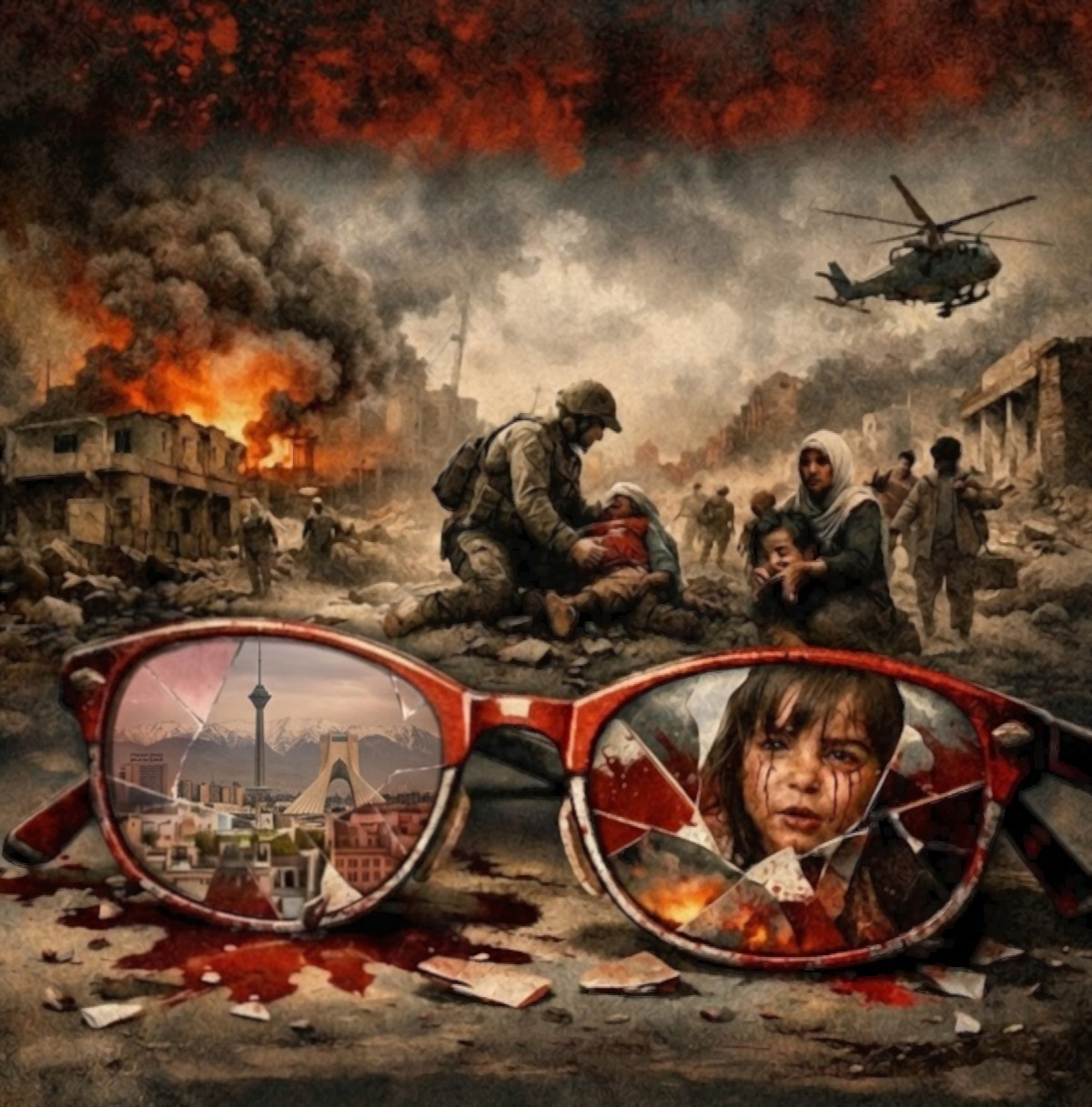
As the glasses shatter, we face the bloody reality of Operation Epic Fury and the cost of impulse.
Edwin Starr’s iconic anthem famously asks, “War… what is it good for?” and answers with a resounding “Absolutely nothing!” It’s a sentiment that resonates deeply, a visceral refusal to accept the scars violence leaves on our social fabric. Does history complicate our protest song? War was, in fact, good for something: it was seemingly the only thing capable of toppling the Nazi regime and crushing the spread of fascism. In that dark chapter of the 1940s, it was chosen as a necessary evil – but only because of a preventable failure. As historians argue, if Western powers had stood up to Hitler in 1936 or 1938 (the “Sudetenland” moment), the “Great Evil” might have been stopped without 60 million deaths.
Now that the bombs have started falling in Operation Epic Fury, we have to grapple with the other side of that coin: what is war not good for?
The View Through Rose-Colored Glasses
In the wake of the massive strikes launched on February 28, there is a carefully curated sense of momentum. With recent reports of the CIA arming Iranian Kurdish forces in Iraq to take on the Islamic Republic, it’s easy to put on rose-colored glasses. We see the headlines about the death of the Supreme Leader, Ayatollah Ali Khamenei, and we want to believe that declaring war will make Iran a democracy. We want to believe that this military intervention will finally give the country back to the people, restoring the freedoms taken away 47 years ago when the regime first solidified its iron grip.
This optimistic haze isn’t just limited to the headlines; President Donald Trump appears to be wearing the rosiest glasses of all. He seems to be riding a high from the Venezuela plan – which went according to plan in terms of toppling a dictator – but he is ignoring the fact that the people of Venezuela didn’t actually gain their freedoms. Instead, they got “new management” that happens to be more compliant with U.S. interests.
This top-down approach is already stumbling. Trump recently admitted that his team had “chosen a few people” within the current Iranian regime to take over, only to follow up that they are all now dead. He spoke of a “second group” and even a “third wave” of potential leaders, and that perhaps they won’t even know them, but this revolving door of hand-picked successors doesn’t equal liberation. If the goal is just to find a “tractable” official who will say yes to Washington, then the “hour of freedom” promised to the Iranian people is nothing more than a hostile takeover disguised as liberation – a replacement of management while the ’employees’ pay in blood. The rose-colored glasses aren’t looking so rosy anymore.
The Constitutional Crossroads
While the administration pushes this “rosy” narrative, a reality check is coming from the Capitol. Today, March 4, Congress is set to vote on a bipartisan War Powers Resolution. This isn’t just some D.C. formality; it’s a direct move to strip the President of his “permission slip” to fight a war of impulse without oversight.
The very language used to describe the conflict is in a state of chaos because of the legal triggers involved. Under the 1973 War Powers Act, once a conflict is officially recognized as “hostilities” or “war,” a 60-day clock begins, after which the President must withdraw troops unless Congress authorizes them to stay. By carefully referring to the conflict as an “operation” or “defensive action,” many Republicans in Congress are trying to avoid starting that clock. They know that under the Constitution, the power to declare war belongs to them, not the Executive. To call it a “war” is to admit the President has overstepped his authority.
When a reporter asked, “If we are bombing a sovereign nation’s capital and its Supreme Leader is dead, how is this not a war?” Secretary of War Pete Hegseth leaned into the microphone and flatly answered, “War is hell and always will be.” Matches his new title change from Secretary of Defense. Moments later, Speaker Mike Johnson – a constitutional lawyer – was seen on the Capitol steps correcting a journalist, insisting the strikes were merely a “defensive operation.”
Like Hegseth, when asked on Tuesday about the mounting civilian casualties, Trump told reporters, “That often happens in war,” and later doubled down by saying, “We’re winning the war, and we’re winning it big.”
The administration wants the “glory” of winning a war without the oversight of fighting one. It is a linguistic shield: using the “war” label for the headlines while hiding behind the “operation” label to avoid the 60-day clock of the War Powers Act.
If the label is up for debate, the actual motive is even more elusive. Secretary Marco Rubio and Speaker Johnson claim a “double preemption” – striking because they “knew” Israel was about to act. On the other hand, President Trump himself told reporters on Tuesday, “If anything, I might have forced Israel’s hand,” directly contradicting Rubio’s claim that Israel was the one leading the way. Vice President JD Vance, meanwhile, told Fox News that the mission is about a “change in mindset” regarding nuclear weapons – a careful phrasing that avoids the “regime change” label the President has already leaned into.
White House Press Secretary Karoline Leavitt went even further on Wednesday, telling reporters that the President ordered the strikes because he had a “good feeling” that an attack on U.S. assets was “imminent.” When pressed for intelligence to back up this feeling, she simply stated it was “based on fact,” yet provided none. Senator Mark Warner – the head of the Intel Committee – has stated on Wednesday that he has seen “no evidence of an imminent threat.”
There is a profound irony in using a nuclear “imminent threat” as the excuse for war in 2026, considering it was Trump who unilaterally dismantled the JCPOA – the agreement designed to prevent this exact scenario – back in 2018. The administration then doubled down on this vacuum of diplomacy by tasking real estate developers Steve Witkoff and Jared Kushner with nuclear negotiations, essentially treating a global security crisis like a property deal. The result is an attempt to solve with bombs a problem Trump 1.0 invited with a pen. Even though less than a year ago, in June, Trump said that Iran’s nuclear program had been obliterated by the joint U.S.-Israeli strikes. And there were supposed to be no wars in Trump 2.0 – he ran on that, he promised that.
The administration has yet to produce a single piece of evidence that Iran was planning an attack on U.S. interests – whether on domestic soil, at embassies abroad, or against naval vessels at sea. Yet the war has appeared to inspire violence on American soil the very next day. In Austin, Texas, the FBI is investigating a mass shooting at a Sixth Street bar as a potential act of terrorism. The gunman, Ndiaga Diagne – a naturalized citizen originally from Senegal – opened fire while wearing a “Property of Allah” hoodie over an Iranian flag T-shirt. Investigators later found that Diagne had expressed pro-regime sentiment online and had photos of Iranian regime leaders in his home.
The casualties of the war within just the first few days make it clear, regardless of the legal dancing in D.C., this in fact is a war. There is a reason the media has been calling it a war from the beginning, just like Trump and Hegseth. 787 Iranians are reported dead, including the 168 schoolgirls and 14 staff killed in a single missile strike on a girls’ school in Minab – an event so devastating that thousands filled the streets in mourning this week. The toll continues to climb: 12 dead in Israel, 52 in Lebanon, and six American service members lost in these first few days.
War – what is it good for? So far, only the proliferation of grief. On Tuesday, U.N. relief chief Tom Fletcher warned of a “daunting” humanitarian fallout, noting that strikes are hitting homes, hospitals, and schools with terrifying frequency. The U.N. is now bracing for a regional catastrophe, predicting that the instability in Tehran could trigger large-scale movements of refugees into Pakistan and Afghanistan.
The rose-colored glasses shouldn’t have just fallen off; they are shattering.
The Kurdish Strategy: Hope vs. History
As the air campaign falters in its promise of a quick victory, the administration is shifting its focus to the ground. One of the most curious aspects of this operation is the openness of the strategy. For years, Trump has mocked his predecessors for “telegraphing” military moves, yet now he is openly announcing the CIA’s plan to have Kurdish forces enter from the West and Northwest to take over territory. Perhaps that’s not accidental.
The choice of the Kurds also isn’t accidental. The Iranian Kurds have been treated horribly by the Islamic Republic for decades, facing systemic marginalization and violent crackdowns – most recently during the 2022 “Woman, Life, Freedom” protests sparked by the death of Jina (Mahsa) Amini. Specifically, the Peshmerga (“those who face death”) are a highly organized, veteran paramilitary force. They are willing to take this gamble because, for them, the fall of the Islamic Republic isn’t just a political goal – it is a matter of survival for their culture, their language, and their very right to exist without the shadow of state-sanctioned execution.
However, we’ve worn these rose-colored glasses before, and they have fallen off and shattered. History warns us of a tragic cycle of betrayal. Usually, it’s the U.S. leaving the Kurds at the altar, but then there’s the 1996 collapse of the ‘Katrina’ mission. During the ‘Operation Azure’ disaster, local factions – feeling abandoned and desperate – invited Saddam’s tanks into the safe haven, leaving CIA officers to stare down the barrels of guns held by the very men they’d been paying. In a survival situation, a D.C. paycheck is no match for a regional reality.
The abandonments were big. We saw it in 1975, we saw it in 1991, and we saw it as recently as January 2026, when the U.S. looked the other way as the Syrian Kurds – primary allies against ISIS – were forced to dissolve their autonomy and integrate into the Syrian government’s ranks. The betrayal is the pattern, and it suggests ‘great plans’ are often built on the assumption that convenient allies are disposable once the tactical objective is met.
In the 1970s, specifically with the 1975 Algiers Accord, the U.S. and the Shah of Iran used the Kurds as leverage against Saddam Hussein, only to abruptly cut off all aid and leave them to be crushed once a diplomatic deal was reached. Henry Kissinger famously dismissed the moral obligation afterward, noting that “covert action should not be confused with missionary work.”
We saw it again in 1991, when President George H.W. Bush encouraged the Iraqi people to “take matters into their own hands.” Sound familiar? The Kurds and Shiites rose up, believing the U.S. had their back, only to be abandoned as Saddam’s helicopter gunships decimated the uprising. While the U.S. eventually set up a No-Fly Zone, the initial silence cost tens of thousands of lives. These aren’t just footnotes; they are the reasons why ‘great plans’ can lead to nightmares rather than a dream.
This brings us to the ultimate contradiction: Even if the bombs do their job and the Peshmerga’s military objective succeeds, how does the U.S. build the “democracy” Trump promised? This is where USAID would traditionally step in. Historically, USAID has been the primary vehicle for “soft power” – rebuilding civil society, training judicial officials, and fostering the democratic institutions necessary to prevent a power vacuum.
But we are operating in a different landscape now. With Trump’s Department of Government Efficiency (DOGE) dismantling USAID in the recent cuts chaos, the very tools needed to turn a military victory into a stable democracy have been largely discarded. Without the infrastructure to support governance and human rights on the ground, the U.S. is essentially knocking down a house with no blueprint or materials to rebuild it. We are left with the “nothing” of war, without the “something” of a sustainable future.
The Chaos Behind the Scenes
If the plan is as solid as the administration claims, the lack of preparation suggests otherwise. While the gears of war were turning, FBI Director Kash Patel was in Milan for the Winter Olympics, where he was seen partying and spraying beer with the gold-medal men’s hockey team. Immediately following this, he fired an elite team of Iran experts (the CI-12 unit) – reportedly because they had worked on the Mar-a-Lago probe. When you purge the people who actually understand the nuances of the regime and replace them with “loyalists,” you lose the expert blueprint needed for a post-war reality.
The most chilling sign of this chaos isn’t found in a press briefing, but on the State Department’s own emergency hotline. As late as Tuesday night, when Americans called for help, they weren’t met with a rescue plan; they were met with a recording that flatly instructed them not to depend on the U.S. government for assisted departure or evacuation. No evacuation points. No government planes. Despite weeks of amassing military hardware for the attack, the Trump administration launched Operation Epic Fury without a single flight manifest for the hundreds of thousands of U.S. citizens now stranded as regional airspaces go dark.
Freedom
We all want the Iranian people to breathe the air of freedom. We want to believe that this latest strategy is the one that finally works. But as we move forward, we must balance our hope with the sobering lessons of history.
Wouldn’t it be nice if we didn’t have to take off the rose-colored glasses because the dream of peace in the Middle East became the reality. We all want the dream to be real. But when the glasses shatter, we are forced to see the world not as we wished it to be, but as we have made it. Hopefully the bleeding doesn’t continue as we pick up the fragmented pieces.
The Final Word: Congress Steps Aside
Senate Vote, March 4: The resolution failed 47–53.
The Breakdown: Only one Republican (Rand Paul) voted for oversight. Only one Democrat (John Fetterman) voted with the GOP to block it.
House Vote, March 5: The measure was defeated 212–219.
The Breakdown: Republicans Thomas Massie and Warren Davidson voted “Yes” to stop the war, but their votes were erased by pro-war Democrats like Greg Landsman and Josh Gottheimer who crossed the aisle to support the strikes.
The Result: The 60-day clock has been officially sidelined. Congress has stepped out of the way, giving the administration a blank check to continue Operation Epic Fury without a constitutional “permission slip.”
Related: Tehran’s Black Rain and Broken Futures: Why Oil Must Be a “No-Go Zone” in War
The “47-Year War”: Did the U.S. Actually Start It 73 Years Ago?
The Dirt is Speaking: From Cyrus the Great to the 2026 Fight for Human Rights
Me We Too posts:
I don’t think Trump should have started the Iran War.
War should be a last resort – not first resort.
And Trump should not have ripped up the Iranian agreement in 2018.
Iranian people are some of the strongest people in the world #freeiran #iranrevolution #womenrights
A whole World War Three is about to happen but people are worried about who got what filler injected
It is ridiculous that Trump expects to be involved in who Iran chooses as their next leader.
Trump obviously does not care about democracy or freedom in Iran







As the war continues, the rose-colored glasses are shattering.
🔗 azipurl.app/fury
#EpicFury #USIranWar #IranWar #MiddleEastCrisis