

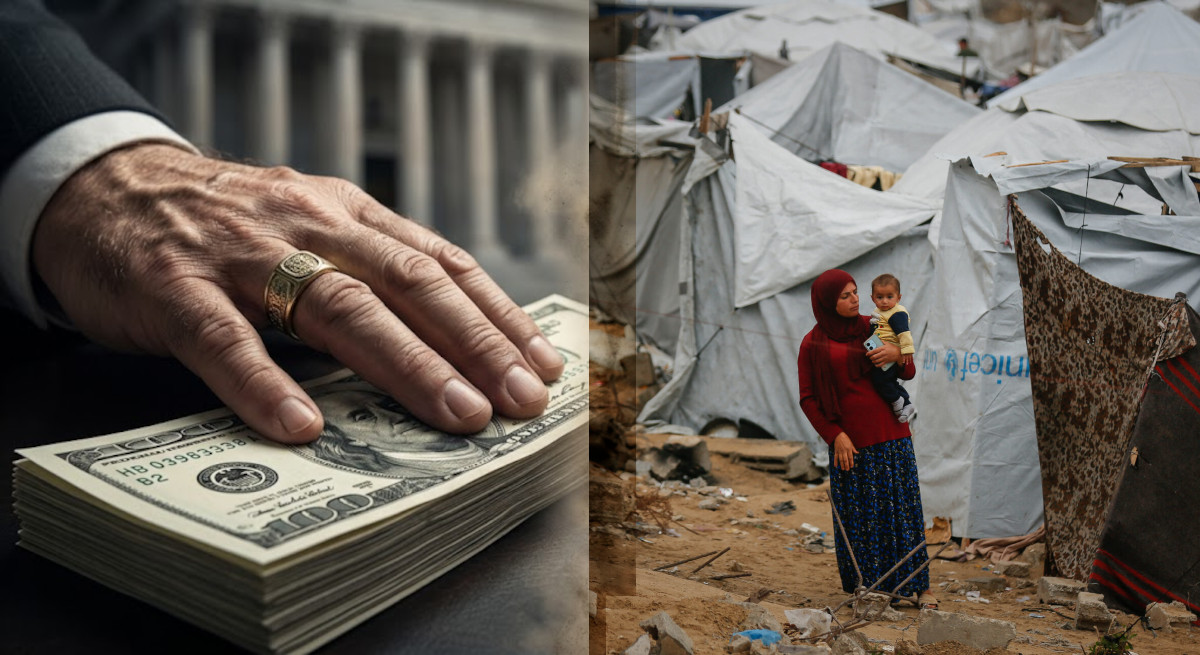
Today isn’t just another procedural vote in Washington.
It’s a moment of clarity.
The U.S. Senate is deciding whether American tax dollars will continue to fund weapons used in the destruction of Gaza and the West Bank. At the center of it are two “Resolutions of Disapproval,” introduced by Senator Bernie Sanders – the only mechanism Congress has to block these arms transfers.
This is one of the rare times the system can actually say no.
To understand what’s at stake, strip away the language of diplomacy and look at the reality of what is being sent, what it does, and who ultimately pays the price.
The Background: A Cycle of Horrific Violence
To understand why we are here, we must acknowledge the darkness of how this began.
On October 7th, 2023, the world witnessed the horrific atrocities committed by Hamas – a terrorist organization that killed 1,200 innocent men, women, and children and took hundreds of hostages.
Like any nation, Israel had the absolute right to defend itself and respond to such a barbaric attack.
But that right to self-defense is not a blank check for unlimited devastation. It does not grant the right to wage an all-out war against an entire people or to violate international law.
As Senator Sanders notes, the response under the Netanyahu government has moved far beyond defense and into the realm of atrocity. When 72,000 Palestinians are killed – the majority being women, children, and the elderly – and 94% of hospitals are reduced to rubble, we are no longer talking about a “targeted response.”
We are talking about the decimation of a society.
This destruction has now spilled across borders. In Lebanon, the same 1,000-pound bombs are being used in densely populated residential areas of Beirut, while the war with Iran threatens to consume the entire region.
What’s Actually Being Approved
To understand what’s at stake, strip away the language of diplomacy and look at the reality of what is being sent:
1,000-pound bombs (S.J.Res. 138) – $151.8 Million:
This resolution seeks to block the sale of 12,000 BLU-110A/B “dumb” gravity bombs. These are not surgical weapons; they are designed for maximum impact, capable of leveling entire city blocks. In densely populated Gaza and Beirut, their use has coincided with the destruction of 90% of housing units, leaving families to live in tents amidst ruins. Human rights monitors have documented their use in Gaza, Lebanon, and Iran.
Armored bulldozers (S.J.Res. 32) – $295 Million:
This resolution is the move to block the sale of a fleet of D9R and D9T Caterpillar bulldozers, including spare parts and logistics support. In the West Bank and Southern Lebanon, these machines are used to demolish homes, schools, and vital infrastructure. Under Netanyahu’s extremist cabinet, these aren’t just construction tools; they are instruments used to “bury” communities and secure ground in an expanding regional war. This vote is the only chance to halt the transfer of machinery that has become synonymous with the erasure of Palestinian and Lebanese neighborhoods.
The Gap No One Can Ignore
There is a widening divide between public opinion and policy.
Polling consistently shows a shift in public sentiment, with roughly 60% of Americans opposing the continued shipment of these weapons.
Yet the shipments move forward.
Critics point to the $127 million spent by lobbying groups in the last election cycle as the reason for this silence.
The question we must ask is simple: If the people want peace, but the money wants war, who does the Senate actually work for?
Why This Vote Matters
Most arms deals happen quietly, buried in bureaucratic paperwork or expedited through “emergency” authorities to avoid a recorded vote.
This time is different.
The urgency of this moment is highlighted by the administration’s recent attempt to bypass the law. Just six days into the war with Iran, the State Department issued an “emergency determination” – a legal maneuver designed to skip the mandatory congressional review period and immediately transfer these weapons.
Because of Senator Sanders’ filing, that maneuver has been checked. Every Senator must now take a position – publicly and on the record. Statements of “concern” or “hopes for de-escalation” are no longer enough.
This is a binary choice: vote Yes to block the transfers, or vote No to let the bombs and bulldozers ship.
There’s no middle ground to hide in.
What This Moment Reveals
This vote goes beyond foreign policy.
It raises a broader question about how the United States defines its role in the world.
Officials often speak of supporting a “rules-based international order” – but that principle is tested when our own tax dollars pay for the bulldozers leveling neighborhoods and the bombs leveling hospitals.
What Happens Next
The vote: Wednesday, April 15
The aftermath: A full record of how each Senator voted – no ambiguity, no interpretation required.
When the roll is called, it won’t just determine the fate of two arms deals.
It will show, in plain terms, how power, policy, and public will intersect in a moment where the consequences are anything but theoretical.
Related: April 7: Has the U.S. Already Crossed the Line into War Crimes?
The 8:00 P.M. Threat: When Rule Breakers Become World Breakers
The Grammar of Silence: Mayor Mamdani and the “Private” Language of City Hall
Related Me We Too polls:
People dying from hunger, innocent lives lost and injured, whole areas leveled – heartbreaking.
The U.S. should not be funding the breaking of international law.
I feel bad for all the innocent people in the Israel-Hamas war.
All the evidence shows that Israel did not hit the hospital in Gaza.
I’m an Independent like Bernie Sanders.
Bernie Sanders would have been an awesome president
Bernie Sanders is for the people
Politicians always are the same .
I think liberal policies are more open and accepting of others, and more helping/caring too
I go for the candidates with liberal ideas
I vote in every election even when not knowing candidates
I hope someone very liberal wins the presidency
Targeting a civilian population’s water systems and power plants is a war crime.







The U.S. Senate is voting on
@sanders.senate.gov’s resolutions to block $450M in heavy bombs and bulldozers.
A moment of clarity: Fund destruction in Gaza and Lebanon, or hold power accountable? No middle ground.
🔗 azipurl.app/senate-arms-vote
#SenateVote #Gaza #Lebanon #ArmsEmbargo #HumanRights