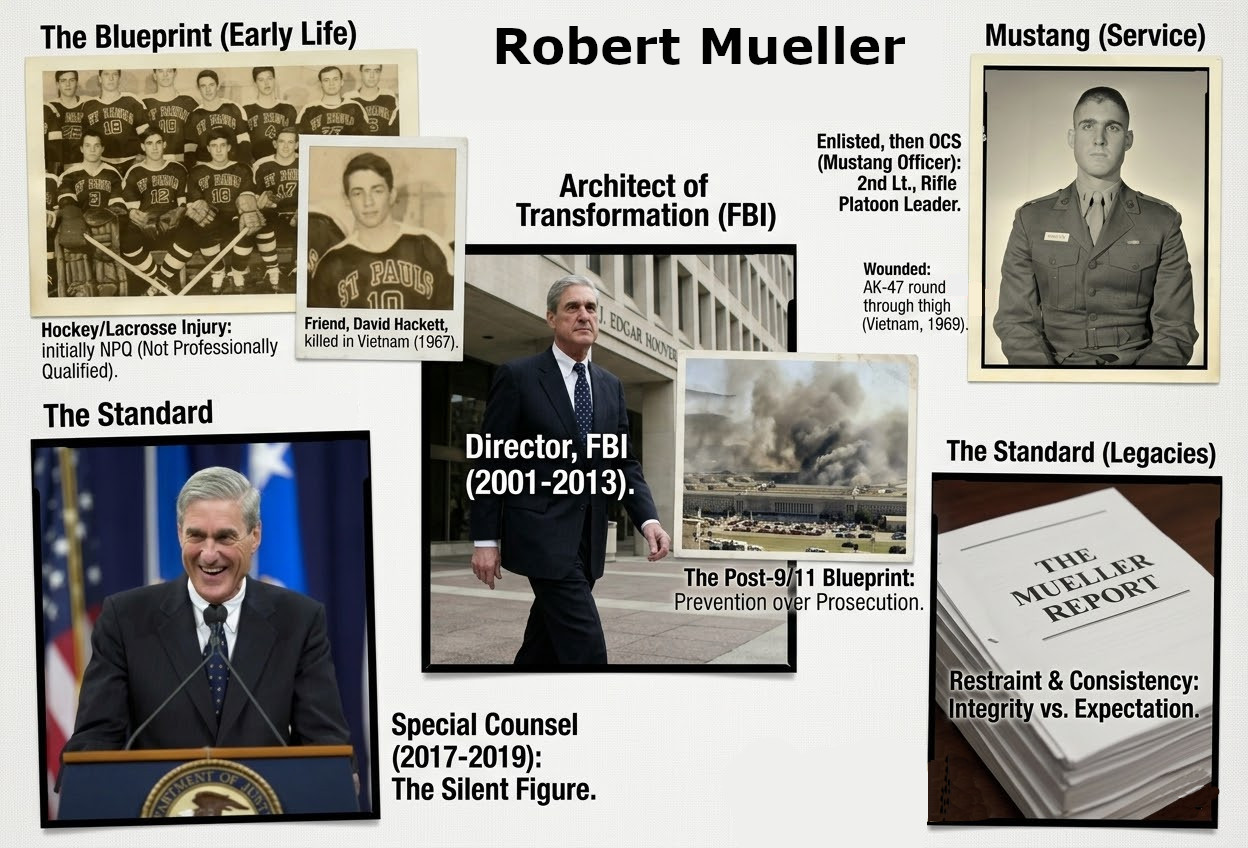
Robert Mueller’s passing at 81 closes the book on a certain kind of American life – one built on discipline, restraint, and an almost stubborn belief in doing things the right way, even when no one is watching.
It’s a kind of life that feels increasingly out of place.
To most people, he was the man at the center of a political storm – a silent figure leading an investigation that consumed a presidency. But long before that, Mueller had already spent decades building a reputation for something far less visible and far harder to define: consistency.
He was, in the old phrase, a straight arrow.
The Choice That Defined Him
Mueller started with every advantage. Prestigious schools. A Princeton degree. A clear path into elite law or business.
He walked away from it.
After his friend and fellow athlete at Princeton, David Hackett, was killed in Vietnam while trying to rescue his men, Mueller chose the Marines. He wanted to go immediately, but years of intense athletics in hockey and lacrosse had left him with a knee injury. When he first tried to enlist after graduation, he was labeled “Not Professionally Qualified” (NPQ).
He didn’t take the “out.” He waited a year for the injury to heal so he could try again.
Despite his Ivy League degree, which would have allowed him to coast into a comfortable officer track, Mueller chose to enlist and go through the grit of Parris Island first – earning the respect of his men as a “Mustang” officer. By April 1969, he was a Second Lieutenant leading a rifle platoon in combat. During a heavy firefight, an AK-47 round tore clean through his thigh. He didn’t immediately realize he’d been hit; he just kept his position and kept directing his men until the ambush was defeated.
He earned a Bronze Star and a Purple Heart. More importantly, he carried that experience with him for the rest of his life.
That decision – away from comfort, toward obligation – wasn’t a detour.
It was the blueprint.
The Homicide Prosecutor
In 1995, Mueller was at the peak of the legal profession. He was a senior partner at a prestigious law firm in Boston, earning a massive salary and handling high-stakes corporate litigation. He had already served as the Assistant Attorney General running the DOJ’s Criminal Division. By any standard, he had “made it.”
But he was miserable.
He didn’t want to bill hours; he wanted to solve crimes. He called Eric Holder, then the U.S. Attorney for D.C., and asked for a job. He didn’t ask for a leadership role or a special appointment. He asked to be a “line prosecutor” in the homicide section – an entry-level position usually reserved for young lawyers just starting out.
Holder was stunned. “I’m getting Bob Mueller for that price?” he famously remarked.
Mueller took a 75% pay cut, moved into a cramped office, and began answering his own phone with a simple, “Mueller, Homicide.” He spent his days at crime scenes and in the city’s toughest courtrooms, prosecuting “street-level” murderers during one of the most violent eras in D.C. history. To the local detectives, he wasn’t a Washington elite; he was “Bobby Three-Sticks,” a nickname that stuck as a sign of respect for his relentless, no-nonsense work ethic.
It was a move that baffled the rest of the legal world, but for Mueller, it was a return to form. He was once again the Marine in the mud, doing the job that needed to be done regardless of the prestige attached to it.
Rebuilding the FBI When It Mattered Most
By the time Mueller became FBI Director in 2001, he had already built a reputation as a prosecutor who took on organized crime and major national cases.
Then, one week into the job, September 11 happened.
The FBI he inherited was built to solve crimes after they occurred. The country suddenly needed something else entirely: an agency that could prevent them.
Mueller forced that transformation.
He pushed the Bureau toward intelligence, coordination, and counterterrorism. It wasn’t flashy work. It was structural. Slow. Often invisible. But it reshaped how the United States approached national security for the next two decades.
The Third-Hardest Job
When Mueller finally left the FBI in 2013, he moved into a high-level law firm partnership. He taught at Stanford. He handled massive corporate settlements. It was a comfortable, prestigious “retirement” for a man who had already given decades to the state.
But in May 2017, the phone rang again. It was Deputy Attorney General Rod Rosenstein requesting that Mueller return to Washington.
The job – overseeing the Special Counsel investigation into Russian interference in the 2016 election – wasn’t something anyone actually wanted. It was a political minefield. For Mueller, this was a final call to public service – a task that arguably ranked as the third-hardest of his life, only trailing the post-9/11 FBI and leading Marines in the jungle.
For nearly two years, he said almost nothing in public.
In a different era, that might have been unremarkable. In this one, it became the story.
People wanted clarity. They wanted conclusions. They wanted a moment.
What they got instead was a document – careful, methodical, restrained. It detailed extensive Russian interference and produced dozens of indictments, but stopped short of charging the sitting president Donald Trump, in line with Justice Department policy, or delivering the kind of decisive resolution many expected.
For some, that restraint was integrity.
For others, it was a failure to meet the moment.
But it was consistent.
He followed the rules – even when the rules frustrated everyone watching.
A Life Without Performance
By the end, Mueller had become something rare: a public figure who never really became a personality.
He didn’t explain himself.
He didn’t market himself.
He didn’t try to win the room.
Even his final years were quiet. His family later revealed he had been living with Parkinson’s disease, a condition that gradually affected his speech and movement.
There was no dramatic exit. No final speech.
Just a slow step back.
What His Life Leaves Behind
Mueller’s career raises an uncomfortable question.
What happens to a system built on rules when the people inside it stop believing in them the same way?
In the hours after his death, Donald Trump posted that he was “glad” Mueller was dead – adding that he could “no longer hurt innocent people.”
Trump seems to cast himself as the ‘innocent’ one – despite Mueller’s report that explicitly declined to clear him.
It was a jarring response, but also a revealing one.
Because if Mueller represented a system built on restraint, process, and silence, that reaction represented something else entirely – louder, more personal, and far less interested in the rules. Not to mention rude and disgusting.
Mueller represented a version of public service that didn’t rely on attention, outrage, or personal branding. It relied on process. On discipline. On the idea that the job matters more than the person doing it.
That model doesn’t generate headlines. It doesn’t dominate timelines.
But it does something else.
It holds things together.
And now that kind of figure is a little harder to find.
Related Me We Too posts:
I love my country, America. But I still can’t believe we went to war in Vietnam.
A felon should not be able to run for President. Or be President.