[LIVE UPDATE: March 31, 2026] — U.S. District Judge Gerald Pappert has issued a ruling in the EEOC vs. Penn case. Scroll to the bottom of this post for the latest details on the Court’s order and Penn’s plan to appeal.
Imagine a federal investigator sitting in a government office in 2026. On their screen is a list. It isn’t a list of criminals. It isn’t a list of suspects.
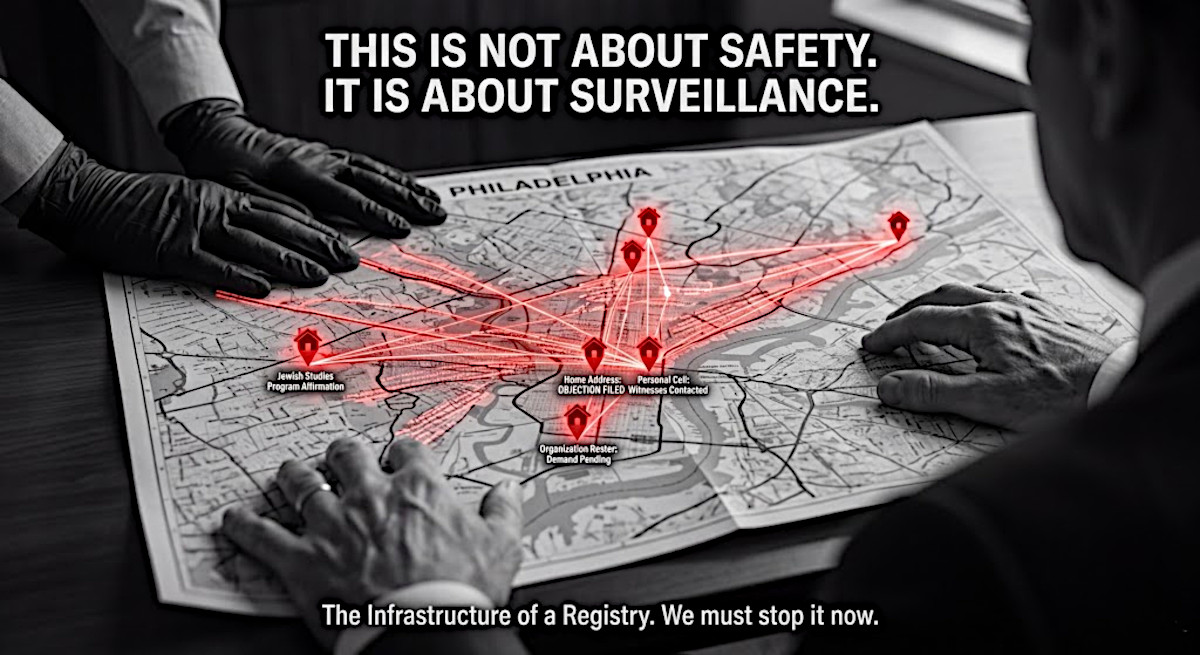
It is a list of names. Names of professors. Names of students. Names of librarians. And next to those names are home addresses, personal cell phone numbers, and a single, defining label: Jewish.
This is not a scene from a history book. This is the documented demand of a federal lawsuit currently sitting on the desk of U.S. District Judge Gerald Pappert in Philadelphia.
The Lucas Charge
This investigation did not begin with a victim coming forward. It did not begin with a whistleblower. It began in December 2023 with a “Commissioner’s Charge” – a specialized legal weapon – filed by Andrea Lucas, a Trump appointee from his first term.
Today, in 2026, the administration is suing to force the University of Pennsylvania to hand over the rosters of Jewish organizations and campus programs. The legal record shows the government is no longer just investigating incidents; they are seeking to assemble a comprehensive roster based on religious affiliation.
The Trump Factor: A Pattern, Not a Coincidence
We have to talk about the man at the top. Donald Trump’s history with the Jewish community is a whiplash of empty gestures and dangerous alliances. On one hand, he claims to be the “best friend” the Jewish people have ever had. On the other, he hosts dinners with people who spend their lives spewing one antisemitic remark after another – people like Kanye West, who has publicly praised Adolf Hitler and the swastika, and white nationalist Nick Fuentes.
This is a man who, according to his former Chief of Staff John Kelly, privately complained that he needed “the kind of generals that Hitler had” because of their “loyalty.” This is a man whose own ex-wife, Ivana, told her lawyer that he kept a book of Hitler’s collected speeches, My New Order, in a cabinet by his bed.
When an administration led by a man who famously refused to fully condemn the neo-Nazis who marched with torches through Charlottesville in 2017 – calling the white supremacists and the people protesting them “very fine people on both sides” – demands a government-mandated roster of religious affiliation, the context is impossible to ignore. In a state-run system, a database of a specific minority group is not just information – it is infrastructure.
The Line in the Sand: 900 Pages of Cooperation, Zero Names
The University of Pennsylvania responded to the EEOC’s suit, writing that they have “cooperated extensively with the EEOC, providing over 100 documents, totaling nearly 900 pages.”
But Penn drew a hard line:
“However, we have not turned over to the government lists of Jewish employees, Jewish student employees and those associated with Jewish organizations, or their personal contact information,” the University statement read. “Violating their privacy and trust is antithetical to ensuring Penn’s Jewish community feels protected and safe.”
The University even offered to help the EEOC reach out to employees who wanted to participate in the investigation.
The EEOC rejected that offer. They didn’t want willing witnesses; they wanted the master list.
In a January 20, 2026 legal brief, Penn’s lawyers described the demands as “disconcerting but also entirely unnecessary,” noting:
“The EEOC insists that Penn produce this information without the consent—and indeed, over the objections—of the employees impacted while entirely disregarding the frightening and well-documented history of governmental entities that undertook efforts to identify and assemble information regarding persons of Jewish faith.”
Following the $21 Million Columbia Precedent
Why is the government pushing for a case without named victims? Look at the money. In the summer of 2025, Andrea Lucas led a similar probe into Columbia University. Without admitting wrongdoing, Columbia paid $21 million into a settlement fund – the largest EEOC public settlement in nearly 20 years.
Penn’s brief reveals that they “immediately sought” specific information about the EEOC’s concerns, but the agency “refused” to provide those details.
By demanding these names at Penn, the EEOC is bypassing the need for a whistleblower to build a case. They are, in effect, suing to find their own plaintiffs. When a government agency refuses a University’s help in finding willing witnesses and instead sues for a secret roster, the evidence suggests a move toward institutional litigation rather than individual protection.
The Shield: A Unified Front
If the government is doing this “for” the Jewish community, why is the community fighting so hard to stop them?
In early 2026, a powerful coalition officially moved to intervene in the lawsuit to block the government’s hand. This isn’t just Penn anymore; it is the ACLU of Pennsylvania, the American Association of University Professors (AAUP), the Jewish Law Students Association, and over 150 individual Jewish faculty members.
They are standing in court to say that the government shouldn’t be allowed to “protect” people by violating their constitutional right to privacy. As ACLU-PA Legal Director Witold Walczak put it, forcing the disclosure of these lists is a “visceral threat” that “conjures a terrifying history.”
The Cold Reality: Why the List is Dangerous
The fear of a registry isn’t theoretical. In January 2024, a list of Penn faculty who went on a solidarity mission to Israel was leaked online with threats that they would be “avenged and should die.” Penn’s lawyers argued that if this government list were leaked, individuals could face “real risk of antisemitic harm,” citing the 2018 Tree of Life shooting and the April 2025 firebombing of Governor Josh Shapiro’s home. When the government demands these rosters, they aren’t creating a file; they are creating a target.
Communications professor Barbie Zelizer told the DP that an investigator called her to ask about the Katz center, to which she is not affiliated. She described the EEOC’s request for personal information of Jewish student and faculty as “unsupportable.” “I don’t know one Jew who doesn’t flinch at the idea that lists of Jews are being compiled,” she said. “I think it’s deplorable, and I’m proud of Penn for pushing back.”
A Lesson from the Gray Offices
While the historical contexts are distinct, we have seen how the architecture of a registry is built, one gray office at a time. The danger isn’t just in the intent of a single investigator; it is in the system itself.
A source familiar with the matter provided a chilling statement to the DP regarding the reality of this investigation:
“Even if the EEOC’s intentions are genuine and sincere, concerns about what would happen if personal information ‘fell into the wrong hands’ are ‘well-founded.’ … This is especially so given the administration’s irresponsible approach to data privacy and security, and its stated commitment to information sharing across agencies. The fact that the EEOC is continuing to pursue this investigation in the way it is, by trying to compel Penn to hand over lists of Jewish employees against the wishes of those employees, makes the calls especially chilling.”
In Nazi Germany in the 1930s and 40s, the machinery of the Holocaust did not begin with a midnight arrest. It began with paperwork in a gray office. It began with census data. Ordinary bureaucrats – just “doing their jobs” – collected membership lists of religious and ethnic organizations. Those bureaucrats weren’t the monsters. But they provided the map for the monsters. They built the list that Adolf Hitler used to find his targets.
The One-Two Punch
Don’t look at the Penn List as an isolated event. While the government in Philadelphia sues to identify and catalog citizens by their faith, they are in Washington tomorrow – Wednesday, April 1, 2026 – asking the Supreme Court to overturn 128 years of settled law in Trump v. Barbara. Not a funny April Fool’s joke.
They are attempting to abolish birthright citizenship, a bedrock that was never revoked even during the height of WWII internment.
While these legal battles are fought in separate courts, the machinery is the same. In Philadelphia, the government builds the infrastructure to identify a specific group. In D.C., they attempt to narrow the pool of who the Constitution protects.
The Universal Threat
During recent hearings in March 2026, Judge Pappert suggested the government’s demand “clears the low bar” of legal relevance. If that “low bar” is all it takes to seize a religious roster, no minority group is safe. If they can demand a Jewish roster today, they can demand a Black Student Union roster tomorrow. They can demand the donor list of a mosque or the names of everyone who attended a Pride event.
They are turning the First Amendment right to peaceable assembly into a high-tech grid for systemic surveillance. They are building the infrastructure of a registry under the guise of civil rights, and they are doing it while we watch.
The record suggests this isn’t about protecting a community. It’s about building a database and creating a path for institutional litigation. It’s surveillance disguised as civil rights – and we must stop it now.
UPDATE: THE COURT RULES (MARCH 31, 2026)
On Tuesday, March 31 – less than 24 hours before the administration heads to the Supreme Court to argue against birthright citizenship – U.S. District Judge Gerald Pappert issued a 32-page ruling siding with the EEOC.
The Ruling: Identifying “Employees” (Including Students)
The Court ordered the University of Pennsylvania to comply with the federal subpoena by May 1, 2026. While the Judge narrowed the scope to exclude rosters of specific Jewish organizations (like Hillel or Chabad), he upheld the demand for the names, home addresses, and personal contact info of all Jewish employees.
At a university like Penn, the term “employees” is a wide net that includes not just faculty and staff, but thousands of student workers, TAs, and graduate researchers. By ordering the “employee” list, the court has effectively granted the government a database that includes a significant portion of the student body.
The Judge’s Reasoning
Judge Pappert dismissed the University’s privacy and First Amendment arguments, calling the comparisons to Nazi-era registries “unfortunate and inappropriate.” He wrote:
“Though ineptly worded, the request had an understandable purpose — to obtain in a narrowly tailored way, as opposed to seeking information on all university employees, information on individuals in Penn’s Jewish community who could have experienced or witnessed antisemitism in the workplace.”
The Rejection of Voluntary Disclosure
Penn and the ACLU argued that instead of being forced to create a religious database, the EEOC should ask employees to come forward directly through a voluntary portal. The Judge rejected this, claiming the EEOC needs the master list to conduct a “thorough” investigation. This effectively forces Penn to act as the government’s list-maker, turning over private data without the consent of the individuals involved.
The University’s Response (The Appeal)
Penn immediately announced it would appeal the decision to the Third Circuit, doubling down on the fact that the government is forcing them to create a religious classification system that does not exist. A Penn spokesperson stated:
“We continue to believe that requiring Penn to create lists of Jewish faculty and staff, and to provide personal contact information, raises serious privacy and First Amendment concerns. The University does not maintain employee lists by religion. We will appeal this decision to ensure our community feels protected and safe.”
Related Me We Too polls:
It is crazy that the Trump admin & EEOC is suing Penn to get a list of Jewish students and staff.