

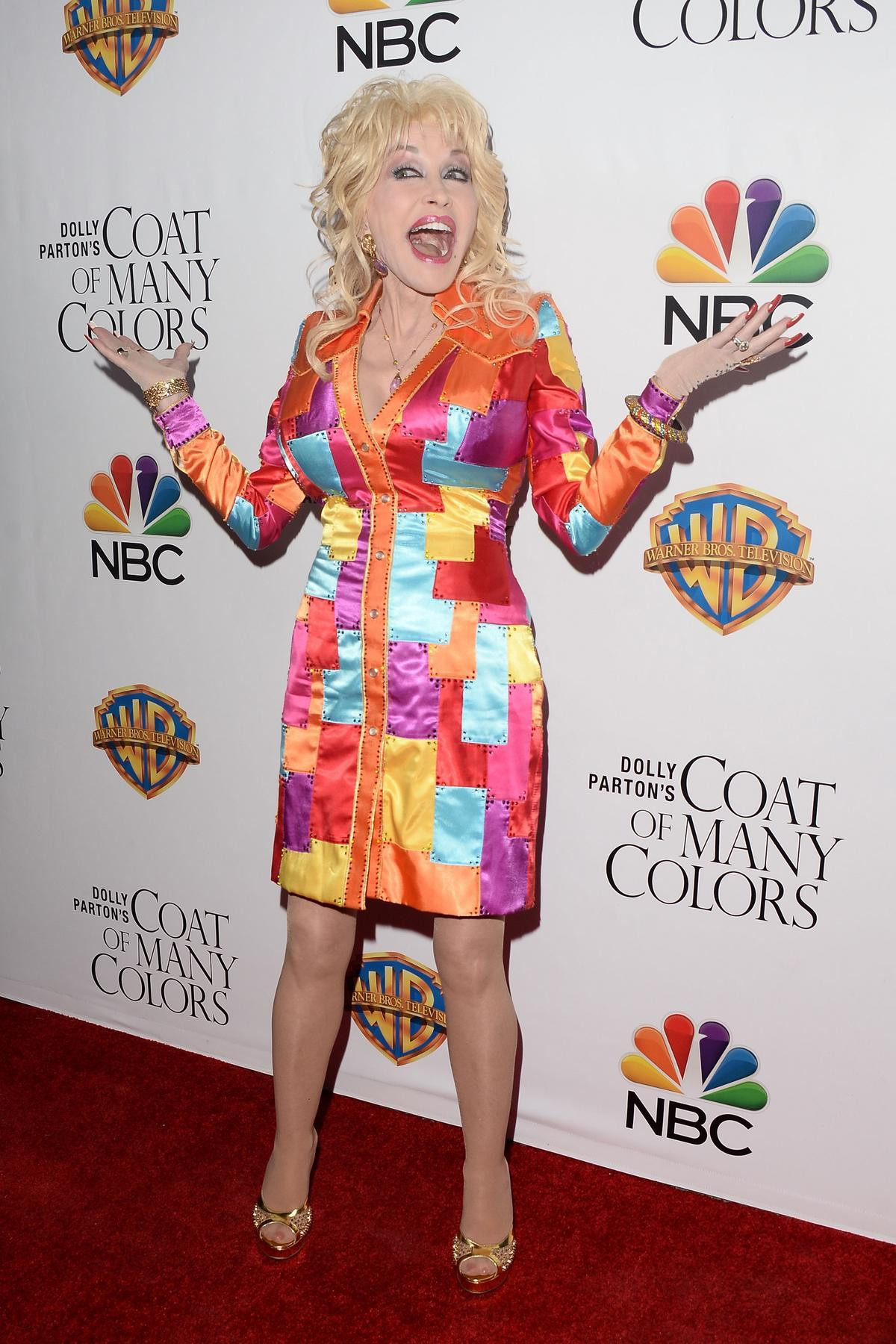
A little girl in the hills of Tennessee walked into school wearing a coat her mother had made for her.
It wasn’t a store-bought coat.
Her mother, Avie Lee, had pieced it together from scraps because there wasn’t enough money for a new one. Dolly was the fourth of 12 children, and the family was very poor. They lived in a small one-room cabin in the Smoky Mountains of East Tennessee, without electricity or running water.
Dolly loved the coat.
The other children didn’t.
They made fun of her for wearing it.
Dolly was proud of it anyway.
Her mother had made it for her, and that was what mattered.
Years later, Dolly turned the memory into one of her best-known songs, “Coat of Many Colors.” She wrote it in just minutes, on the back of a dry-cleaning receipt while riding on Porter Wagoner’s tour bus.
The song became much more than a story about an old coat. It was about her mother, poverty, childhood, being teased, and the difference between what something costs and what it means.
The original childhood coat was eventually worn out as it was passed down through the family. A replica of the coat is displayed at Dollywood.
The story eventually made its way onto television, too. In 2015, NBC aired Dolly Parton’s Coat of Many Colors, a made-for-TV movie based on her childhood and the story behind the song. A sequel, Dolly Parton’s Christmas of Many Colors: Circle of Love, followed in 2016, continuing the story of young Dolly and her family.
The little girl who was laughed at for being different eventually became one of the most recognizable people in the world.
And she never stopped being Dolly.
She Decided She Was Going to Look Like Herself
Dolly’s appearance was something people would have plenty to say about throughout her life.
When she was young, she noticed a woman in her hometown whom people called the “town tramp.” Dolly didn’t see her the way other people did. She saw the bleached blonde hair, red lipstick, high heels and glamorous clothes.
Dolly thought she was beautiful.
She decided that was how she wanted to look when she grew up.
And she did.
Big blonde hair. Makeup. Long nails. High heels. Sparkles. Rhinestones. More hair, more makeup, more everything.
People in the music business told Dolly she should tone down her look if she wanted to be taken seriously as a singer and songwriter. Chet Atkins, who was running RCA at the time, was one of them.
Dolly thanked him for the advice.
And then she did the exact opposite.
As Dolly puts it, “And of course, I just got worse with it.”
Years later, after Dolly had become a star, Chet came up to her and said, “Now, ain’t you glad you listened to my good advice?”
They laughed about it.
The look that some people thought was too much eventually became one of the most recognizable looks in entertainment.
She Wasn’t Dumb – Or Blonde
People also had another label for Dolly: “dumb blonde.”
It never bothered her much. In fact, she turned the stereotype into a song, “Dumb Blonde,” in 1967, singing, “Just because I’m blonde, don’t think I’m dumb.”
Dolly knew she wasn’t dumb.
And, as she has pointed out, she wasn’t even really blonde.
Her famous blonde hair was part of the look she had chosen for herself. The “dumb” part was something other people had decided for her.
The woman with the big hair, high heels, rhinestones and exaggerated makeup wasn’t trying to look like everybody else.
She was trying to look like Dolly.
And she knew exactly what she was doing.
She Wanted to Be Rich and Famous
Dolly wasn’t shy about having big dreams.
As a child, she wanted to be rich and famous.
And she got both.
She began performing when she was very young. At 13, she made her first appearance at the Grand Ole Opry in Nashville.
After graduating from high school in 1964, she didn’t spend much time wondering what to do next.
She left for Nashville the very next day with her cardboard suitcase.
And on her first day there, she went to a laundromat.
That’s where she met Carl Dean, her future husband: “He’s always loved who I was, and I loved who he was, and we never tried to change each other.”
They married in 1966 and remained together for nearly 60 years, until Carl died in 2025.
Carl also inspired one of Dolly’s biggest songs.
Shortly after they married, Dolly noticed a red-haired bank teller flirting with Carl. The teller had a crush on him, and Carl enjoyed the attention.
Dolly was jealous – and turned the whole situation into “Jolene,” imagining a beautiful woman trying to take her man away. Dolly later joked that the woman had things she didn’t have – especially her height and long legs.
The woman wasn’t actually named Jolene. Dolly got that name from a young red-haired fan who had once asked her for an autograph.
“Jolene” gave people a rare glimpse into Dolly’s personal life with Carl. They generally kept that part of their relationship private.
She Wrote the Song Many People Think Whitney Houston Wrote
One of Dolly’s biggest songs started with her trying to leave.
Dolly had spent seven years working with Porter Wagoner on The Porter Wagoner Show. He had given her a major break, and they had become a hugely successful professional team.
But Dolly had always wanted to be a solo star.
When it was time for her to leave the show, the two of them argued about it.
Dolly later said she finally realized there was only one way to make Porter understand how she felt.
She went home and wrote a song.
That song was “I Will Always Love You.”
It wasn’t written as a romantic love song.
It was Dolly’s goodbye to Porter.
She had been grateful to him. She loved him in her own way. But she wanted to go out on her own.
The next day, Dolly took the song to Porter and sang it to him.
He cried.
Then he told her it was the prettiest song he had ever heard and said she could leave – if he could produce the record.
He did.
Dolly’s original recording became a No. 1 country hit.
But that was only the beginning of the story.
Years later, Elvis Presley wanted to record the song.
Dolly was thrilled.
Then Elvis’s manager, Colonel Tom Parker, told her that if Elvis recorded it, they would need a large share of the publishing rights.
Dolly said no.
It was one of the hardest business decisions she had ever made. Elvis could have made the song enormously successful, and people told Dolly she was making a mistake.
But she didn’t want to give away the rights to a song she had written.
She kept them.
She would eventually be proven right.
In 1992, Kevin Costner was producing and starring in The Bodyguard with Whitney Houston. The movie needed an important song, and Costner suggested Dolly’s “I Will Always Love You.” Whitney recorded a completely different version of it, turning Dolly’s country ballad into a huge pop and R&B ballad.
It became one of the biggest songs in music history.
Whitney Houston’s version spent 14 consecutive weeks at No. 1 on the Billboard Hot 100.
Suddenly, millions of people thought of the song as Whitney Houston’s song.
Dolly didn’t seem to mind.
She had written it.
And she owned the publishing.
The enormous success of Whitney’s version meant enormous songwriting royalties for Dolly.
There was something very Dolly about the whole thing.
Whitney could have the spotlight.
Dolly would take the money.
And she had a use for it.
Dolly later used royalties from Whitney’s recording to purchase a commercial property in a predominantly Black neighborhood in Nashville. She referred to it as “the house that Whitney built.”
The song had started as Dolly’s way of saying goodbye to a professional partner who didn’t want her to leave.
Nearly 20 years later, it had become a worldwide phenomenon.
She Really Did Get the Dream
Julia Roberts once told a wonderful story about Dolly from the time they were filming Steel Magnolias in Louisiana.
It was extremely hot.
People were complaining about the heat, asking for water and wondering how much longer they could take it.
Julia asked Dolly how she could stand it without complaining.
Dolly’s answer was very Dolly.
When she was a little girl, she had wanted to be famous and rich.
Now she was famous and rich.
So she wasn’t going to complain about the heat.
Julia said that after hearing that, she decided to be quiet for the rest of the day.
It was a funny little exchange, but it is also a good glimpse of Dolly’s personality. She knew she was living the life she had once dreamed about.
She Built Dollywood
Dolly didn’t just dream about becoming famous.
She dreamed about doing things that seemed much bigger than what some may have thought a little girl from the Smoky Mountains could reasonably expect to accomplish.
One of those dreams was Dollywood.
In 1986, Dollywood opened in Pigeon Forge, Tennessee, near where Dolly grew up.
She had brought Hollywood back to the Smoky Mountains.
But Dollywood wasn’t simply about putting Dolly Parton’s name on a theme park.
It was also a way to celebrate the mountains, the people and the culture she came from, while creating jobs and opportunities in the area.
The girl who had left Tennessee to chase a dream eventually came back and built something there.
She Helped Other Artists Find Their Way
Dolly didn’t just build a career for herself.
She helped other artists build theirs, too.
One of the most personal examples was her goddaughter, Miley Cyrus. Dolly had known Miley since she was a baby and became her godmother through her close friendship with Miley’s father, Billy Ray Cyrus.
Dolly even appeared on Hannah Montana, playing Miley’s godmother on the show.
As Miley grew from a Disney star into a recording artist in her own right, Dolly remained a supporter, collaborator and mentor.
When Miley began moving away from her wholesome Disney image and people criticized the changes in her appearance and music, Dolly defended her.
Dolly understood what it was like to have people tell you what you should look like, how you should act and what kind of artist you were supposed to be.
She never told Miley to become more like Dolly.
She encouraged her to become Miley.
And Dolly didn’t just support Miley privately. She gave her opportunities to grow as an artist, too. They performed together repeatedly, including “Jolene,” and Dolly collaborated with Miley on “Rainbowland” and “Wrecking Ball.” Miley has spoken about how much she learned from her godmother.
Dolly did the same kind of thing for other artists.
When Reba McEntire was struggling to get back onstage after the 1991 plane crash that killed members of her touring band, Dolly offered her something far more useful than sympathy: “Here, take my band.”
That was Dolly.
She didn’t just tell people they could do it.
Sometimes, she helped give them what they needed to do it.
Sometimes that meant showing up.
Brandi Carlile experienced that firsthand. Dolly recorded Carlile’s song “The Story” for a 2017 charity album after Carlile specifically asked her to be part of the project. Two years later, at the 2019 Newport Folk Festival, Dolly made a surprise appearance during Carlile’s all-female set, walking onto the stage to join Carlile, Sheryl Crow, Judy Collins and the other performers. Dolly and Carlile then sang “I Will Always Love You” together.
Dolly didn’t just lend her voice. She lent her credibility. She was telling the audience, in effect: I believe in this artist.
And Dolly didn’t stop with Brandi. At that same Newport festival, she brought a group of younger female artists onto the stage to perform “9 to 5,” including members of the newly formed Highwomen.
Dolly knew what a moment like that could mean for an artist trying to find her way.
Over the years, countless singers and musicians looked to Dolly as an inspiration, collaborator, friend or example of what was possible.
Taylor Swift captured that part of her legacy beautifully: “I am grateful for the tightrope she walked so that young girls like me could grow up dreaming of joining the circus too.”
She didn’t just walk the tightrope.
She made the path wider for everyone coming behind her.
She Never Forgot What It Was Like to Have Very Little
Dolly became extraordinarily successful.
But she never seemed to forget what it was like to grow up without much.
That became one of the most remarkable parts of her life.
Her philanthropy included:
- The Buddy Program, which she started in Sevier County in the early 1990s. Students chose a buddy and promised to help each other stay in school and graduate. If both graduated, Dolly gave each of them $500. The program helped reduce the dropout rate in participating classes from about 35% to 6%.
- Dolly Parton’s Imagination Library, started in 1995, which sends a free, age-appropriate book every month to registered children from birth through age five. What began in her home county eventually became an international program that has distributed hundreds of millions of books.
- Scholarships for students.
- Support for schools and school programs, including the Sevier County High School band.
- Children’s hospitals and pediatric cancer programs, including a $1 million gift to Vanderbilt Children’s Hospital in honor of her niece Hannah, who had been treated there for leukemia.
- COVID-19 research, including a $1 million donation to Vanderbilt University Medical Center in 2020. The research helped support work that contributed to the development of the Moderna vaccine.
- Disaster relief, including the My People Fund after the 2016 wildfires in her home area.
- Scholarships for wildfire victims and other assistance for families recovering from the fires.
- HIV/AIDS causes, including contributing the song “You Gotta Be My Baby” to the 1994 benefit album Red Hot + Country, which raised money to fight HIV/AIDS.
- Environmental and conservation causes, including bald eagle conservation.
- Medical research and children’s health, including major gifts to Vanderbilt and other institutions.
- And countless smaller acts of generosity that never became major headlines.
Dolly received the Carnegie Medal of Philanthropy in 2022, and her charitable giving continued into her final years. In 2024, for example, she gave $1 million to Hurricane Helene relief in East Tennessee, with her businesses and organizations – including Dollywood, the Dollywood Foundation, Dolly Parton’s Stampede and Pirates Voyage – matching it with another $1 million.
The list is long.
And it isn’t limited to one type of cause.
The Buddy Program Wasn’t Just a Check
The Buddy Program is particularly interesting because Dolly wasn’t simply handing out money.
She was trying to get kids to stay in school.
Every participating seventh- and eighth-grade student was paired with a buddy. The two students signed a contract promising to do everything they could to make sure they both graduated from high school. If both graduated, Dolly gave each of them $500.
And it worked.
The dropout rate for the participating classes fell dramatically.
Dolly had taken something she had and turned it into an incentive for kids who needed a reason to keep going.
Her Father Couldn’t Read or Write
The story behind the Imagination Library is even more personal.
Dolly’s father, Robert Lee Parton, was smart and hardworking, but he had never learned to read or write.
Dolly never forgot that.
So she created a program that would put books into the hands of children.
The first books went to children in her home county.
Then the program grew.
And grew.
Today, a child can receive a book every month from birth until age five, free of charge to the family.
As of June 2026, more than 325 million books have been gifted through the program.
The idea began with Dolly thinking about her father.
It ended up reaching children all over the world.
She Didn’t Have Children of Her Own
Dolly and Carl never had children.
But children were always a huge part of Dolly’s life.
She had eight younger siblings and helped care for some of them. Her nieces and nephews were also an important part of her life.
They called her Aunt Granny.
Dolly once said that perhaps she wasn’t meant to have children of her own because then everybody’s children could be hers.
And in a very literal sense, she spent much of her life looking after children who weren’t technically hers.
Millions of them.
When Her Niece Needed Her
Dolly’s philanthropy was often connected to something personal.
Her niece Hannah was diagnosed with leukemia as a child and spent years being treated at Vanderbilt Children’s Hospital.
Hannah survived.
Dolly wrote the song “Chemo Hero” for her.
And in 2017, Dolly announced a $1 million gift to the hospital’s pediatric cancer program in honor of Hannah and the people who had cared for her.
It was one of many times Dolly took something personal and turned it into something that could help other people.
When Her Hometown Burned
In November 2016, devastating wildfires swept through Sevier County, Tennessee.
The area Dolly had grown up in was burning.
Homes were destroyed.
People lost everything.
Dolly’s response came quickly.
The My People Fund was established within 48 hours.
Families whose homes had been destroyed or made uninhabitable received $1,000 every month for six months.
The final distribution was increased from $1,000 to $5,000 per family, because of the additional donations that came in.
The fund eventually distributed more than $12 million, with additional money going toward recovery and scholarships.
Dolly called the people affected by the fires “my people.”
That was a phrase she had earned.
And Then There Was the Vaccine
During the early months of the COVID-19 pandemic, Dolly donated $1 million to Vanderbilt University Medical Center for COVID research.
That money helped support research that contributed to the development of Moderna’s mRNA vaccine.
When Dolly later became eligible to receive the vaccine herself, she didn’t expect special treatment.
She waited her turn.
And when she finally got the shot in March 2021, she did what Dolly does.
She turned it into a song.
To the tune of “Jolene,” she sang:
“Vaccine, vaccine, vaccine, vaccine, I’m begging of you, please don’t hesitate.”
Then came the punchline:
“Because once you’re dead, then that’s a bit too late.”
She was joking, but she was serious about the message. Dolly wanted people to get vaccinated.
Dolly and the LGBTQ+ Community
Dolly also had a long-standing connection with the LGBTQ+ community.
She supported LGBTQ+ rights, welcomed LGBTQ+ visitors to Dollywood, and hosted a Gay Day at the park. When the event attracted threats, Dolly’s response was essentially that she wasn’t going to stop loving people because somebody else disapproved.
“I love everybody,” she said at the time.
She also spoke publicly about accepting people for who they are.
In a 2016 interview, when asked about her support for gay people, Dolly said, “If you’re gay, you’re gay. If you’re straight, you’re straight,” and said people should be allowed to be who they are.
She also contributed to the 1994 Red Hot + Country AIDS benefit album, which raised money for HIV/AIDS causes.
And then there is one of the funniest Dolly stories of all.
Dolly Parton Lost a Dolly Parton Look-Alike Contest
Dolly once entered a Dolly Parton look-alike contest.
The contest was held at a Los Angeles bar and featured drag queens dressed as Dolly and other celebrities.
Dolly decided to enter herself.
But she didn’t just walk in looking like Dolly.
She made herself look even more Dolly.
She made her beauty mark bigger.
She made her eyes bigger.
She made her hair bigger.
She exaggerated everything.
Then she got in line with the other contestants without telling anyone who she was.
Nobody recognized her.
When she walked across the stage, the judges and audience thought she was just another contestant.
Dolly said they thought she was “some little short gay guy.”
And she got the least applause.
She thought it was hilarious.
The other contestants had spent weeks and months putting together their Dolly outfits.
Dolly had simply shown up as Dolly turned up to 11 – and still lost.
She Could Make Music With Her Fingernails
Dolly’s acrylic nails were not just part of her look.
They became an instrument.
When she was working on “9 to 5,” she discovered that clicking her long acrylic nails together could make a sound like a typewriter.
So she used them to create the rhythm.
The recording even includes a credit for “Nails by Dolly.”
She had the nails.
They made a sound.
So she used them.
That’s about as Dolly as it gets.
She Had a Song That Nobody Has Heard Yet
Dolly was thinking about the future, too.
In 2015, she wrote and recorded a song called “My Place in History.”
Then she put it in a time capsule at Dollywood’s DreamMore Resort.
The instructions say it is not to be opened until January 19, 2046 – what would have been Dolly’s 100th birthday.
She even put a CD player in the box so that whoever opens it will be able to listen to the song.
Dolly later admitted that she regretted putting it away because she thought it was a really good song.
But she left it there anyway.
Somewhere in Tennessee, a locked box is waiting for January 19, 2046.
There’s still a Dolly Parton story waiting to be heard.
She Left the World a Lot More Dolly
Dolly Parton died on August 25, 2026, at the age of 80.
She left behind one of the most remarkable legacies in entertainment – not just through her music, but through Dollywood, her philanthropy, her humor and the millions of people she helped.
And much of that generosity came from remembering exactly where she had started.
The world is already showing just how much she meant to people.
Flowers have covered her star on the Hollywood Walk of Fame.
The Empire State Building lit up in pink sparkle in New York City, with the tribute timed around 9:25 p.m. as a nod to “9 to 5.”
In London, the Band of the Coldstream Guards played “9 to 5” during the Changing of the Guard at Buckingham Palace.
And across the United States, American flags were ordered to fly at half-staff for a week in her honor.
On the very day Dolly died, federal Judge David Hittner in Texas invoked Dolly while striking down Senate Bill 12, the state’s restrictions on drag performances, as an unconstitutional restriction on speech.
Dolly wasn’t a random example. One of the plaintiffs, drag performer Brigitte Bandit, performs as Dolly and had testified against the law. Dolly later sent her a rhinestone-covered guitar.
Hittner noted that Dolly herself had been criticized as a “voluptuous sex symbol” because of her big hair, flamboyant clothes and revealing appearance. His conclusion was simple:
“Just don’t go.”
Dolly spent decades being told that she was too much – too blonde, too big-haired, too made-up, too glamorous, too different.
Meanwhile, she was writing songs. More than 3,000 of them.
She never changed.
She just kept being Dolly.
And she spent much of her life helping other people be more of themselves, too.
It looks like that won’t change.





Dolly Parton was laughed at as a little girl for wearing a coat made from scraps.
She became one of the world’s biggest stars – and never stopped being herself or helping others.
Her music, philanthropy, humor, and a song locked away until 2046. #DollyParton
Read her story:
azipurl.app/dolly