Imagine a weapon you can’t see, can’t aim, and that keeps killing for decades after it’s deployed.
War already has one.
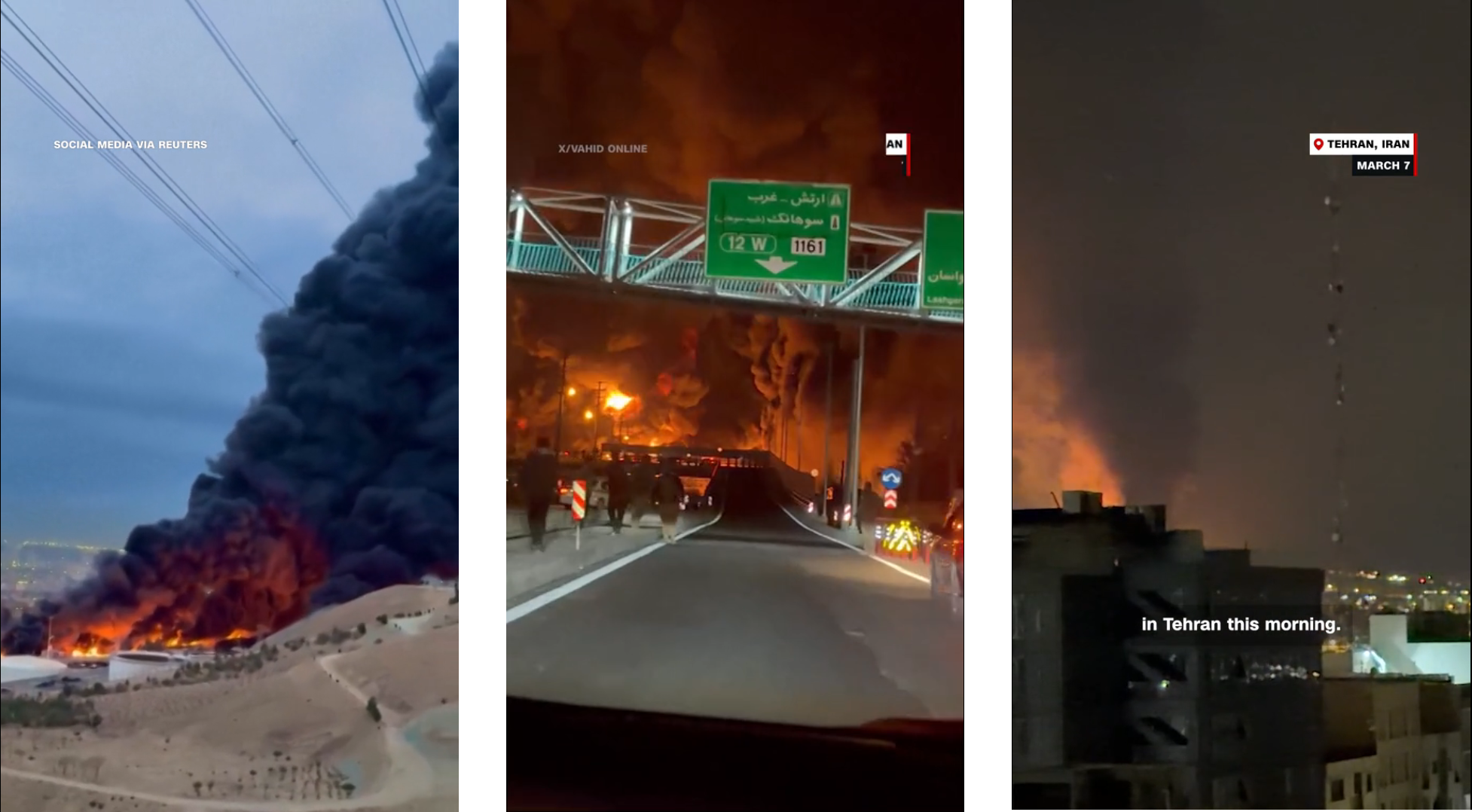
In Tehran tonight, the scene is apocalyptic. Residents describe a ‘black monster’ swallowing the sky as a glow of deep crimson and orange reflects off thick, oily clouds. It looks like “the end of the world,” or ‘hell’ as one survivor put it. Fuel ignited by the strikes is now surging through city sewers and drainage channels, turning streets into rivers of fire.
The soot falling over the city this week is not just ash; it is a slow-motion chemical attack. In this kind of warfare, the damage isn’t measured in minutes or immediate casualties. It’s measured in decades: rising cancer rates, birth defects, poisoned soil, and collapsing ecosystems
Chemical Warfare by Proxy: The Cruelty of the Cloud
International law strictly prohibits chemical weapons because they are indiscriminate and exceptionally cruel. They were banned not just because they hit civilians, but because they cause “superfluous injury” – a level of agony no military objective can justify.
Hitting an oil refinery is a chemical attack in all but name. The combustion of crude oil releases a “toxic cocktail” of benzene, sulfur dioxide, nitrogen oxides, and fine particulate matter. These aren’t just pollutants; they are agents of torture that sear the lungs and cause chemical burns on the skin. If we have already agreed as a civilization that making a weapon that “prevents people from breathing” is a depraved act, then we must apply that same logic to the intentional destruction of energy infrastructure. You cannot “aim” a toxic plume; it drifts into schools and nurseries with cruel indifference.
Intergenerational Debt: The Theft of the Future
This is not a war between current combatants; it is a war against the future. Unlike a missile strike, which ends when the dust settles, the toxins released in these fires are invisible predators. While we are currently seeing reports of “soot-cough” and acute respiratory distress, the true toll will manifest years from now.
We have seen this slow-motion catastrophe before. More people have now died from 9/11-related toxic exposure than died in the attacks themselves – largely because they were officially told the air was “safe to breathe.” Behind the scenes, the White House pressured the EPA to delete cautionary data from press releases, lulling responders into a false sense of security. Though workers viewed the “dust” as a nuisance, it was actually a pulverized cocktail of 400 tons of asbestos, lead, and mercury. Many worked without respirators, unaware that these toxins were penetrating the blood-brain barrier and causing irreversible DNA damage.
“In the movies, mutations give people superpowers. In the real world, they give children cancer.”
In Tehran, the soot falling today is an even more volatile ticking time bomb. While state media initially downplayed the strikes as “under control,” the narrative has shifted to one of victimhood. They now characterize the plumes as evidence of “intentional chemical warfare,” yet they continue to prioritize logistical stability – insisting that gasoline reserves are “sufficient” – while millions are left to choke on the reality outside their windows.
The Iranian Red Crescent Society (IRCS) issued an emergency warning that the capital is facing “toxic precipitation” – black, oily raindrops falling from a sky so thick with smoke that residents are driving with headlights on at noon. This isn’t just a fire; it is a rain of unrefined hydrocarbons and sulfur oxides. The people of Tehran are being told that touching the rain could cause chemical skin burns. More terrifyingly, as those droplets evaporate, they release concentrated gases into the streets, making every breath a lottery for long-term lung damage. These aren’t just pollutants; they are genotoxins that can penetrate the blood-brain barrier and cause irreversible DNA damage, permanent mutations.
This poison is now sinking into the earth. These heavy metals and carcinogens will eventually leach into groundwater basins, poisoning the literal lifeblood of the region for decades. Long after the “Mullahs” or the current generals are gone, the land itself will remain a “Zone of Sickness,” sentencing future generations of Iranians to a health crisis they did nothing to deserve.
In the movies, mutations give people superpowers. In the real world, they give children cancer.
The “Economic Hostage” Fallacy
Military planners often argue that energy infrastructure is a legitimate strategic target. Oil fuels armies, aircraft, and missile systems, making it an attractive objective in wartime.
But the claim that these strikes “only target the regime’s pockets” is a dangerous myth. In any resource crisis, a regime will prioritize its own survival. The remaining fuel will always go to the military and security apparatus first. The Iranian government has already officially cut fuel quotas for civilians in the capital, reducing the limit from 30 liters to 20 liters.
The people who lose are the civilians. When the oil stops, the ambulances stop running. Food supply trucks stall. Water treatment plants, which require this energy, fail. Hitting oil doesn’t “starve the regime” – it holds 85 million people hostage by collapsing the basic pillars of human survival.
The Desalination War: The Illegal “Off-Switch” for Civilization
This cycle of destruction has no borders.
On March 7, 2026, Iranian Foreign Minister Abbas Araghchi condemned a strike on the Qeshm Island freshwater desalination plant that left 30 villages without water, calling it a “blatant and desperate crime.” He warned that the U.S. has set a dangerous precedent by targeting civilian lifelines.
President Trump has stated he was “unaware” of that specific attack when asked by reporters on Air Force One, and pivoted the conversation back to the overall success of the campaign, saying, “Tremendous progress has been made, as you’ve probably been watching” (we can trust him because his Press Secretary Karoline Leavitt says “President Trump does not lie”). CENTCOM spokesperson Navy Capt. Tim Hawkins issued a standard denial regarding the targeting of civilian infrastructure: “U.S. forces do not target civilians – period, ” while White House and Pentagon officials have referred inquiries to the Department of Defense, noting that there is an “ongoing investigation”. Israel and the UAE have issued formal denials as well.
This messaging stands in stark contrast to the rhetoric oozing from President Trump’s Truth Social post on March 7, 2026: “Today Iran will be hit very hard! Under serious consideration for complete destruction and certain death… are areas and groups of people that were not considered for targeting up until this moment in time.” This was after the first reports of the Qeshm Island desalination strike began circulating on social media and just as Iranian state media began teasing the Foreign Ministry’s formal condemnation cable.
Why the wall of denials for the water strike? Because targeting drinking water is a blatant war crime – a violation of International Humanitarian Law (IHL), specifically Article 54 of Protocol I, that prohibits the destruction of lifelines indispensable for human survival. In a region where 90% of drinking water is manufactured, these facilities are the ‘off-switch’ for civilization. When you hit water, you are targeting the very biology of the citizens. It is a slow-motion forced evacuation – warfare that uses thirst to make a land uninhabitable.
The “Black Rain” Loophole
While the water strike is met with denials, the destruction of oil is met with brags. Israel and the U.S. continue to expand the ‘Black Rain’ over Tehran, moving from the initial hits in Aghdasieh, Shahran, and Shahr Rey – where oil is literally leaking into the streets – to the massive Tehran Refinery and storage sites in Karaj. This is the loophole: they brag about hitting oil depots because “fuel is for tanks.” They hide behind a legal technicality while the citizens of Tehran are rained on by poison.
This remains a coordinated effort: the U.S. calls its mission “Operation Epic Fury,” focusing on the regional supply chain, while Israel executes “Operation Roaring Lion” (a cynical nod to the lion on Iran’s traditional flag) within the capital’s industrial zones.
The retaliation was swift, but nothing matching the “Black Rain” over Tehran: the IRGC launched ballistic missiles at the Haifa refinery in Israel, while an Iranian drone strike damaged a desalination plant in Bahrain today. Bahrain reports that its water network remains stable after the drone hit.
Whether you die of thirst because of a “denied” water strike or die of cancer because of a “legal” oil strike, the result is the same: you are a casualty of a war that has forgotten how to be human.
Whether the soot falls on a street in Tehran or a balcony in Haifa, the result is the same: a generation of civilians left to breathe and drink in the failure of their leaders.
The Bottleneck of Thirst: When the Oil Stops, the Aid Stalls
This is why the legal distinction between “military” oil and “civilian” water is a fantasy. When you kill the fuel, you kill the cure.
The IRCS has formally submitted a report to the International Criminal Court (ICC) alleging that over 6,600 civilian structures have been hit. They are trying to rush water tankers to those 30 parched villages on Qeshm Island, but they are paralyzed. There is no fuel for the trucks. Continued “double-tap” strikes – an illegal tactic the IRCS officially alleges is being used by Israel and U.S.-led forces to hit targets a second time once medics arrive – make movement a suicide mission.
Even the world’s help is being choked off. The International Federation of Red Cross and Red Crescent Societies (IFRC) reported today that vital water purification supplies are currently stuck in a Dubai hub because the Strait of Hormuz has become a de facto no-go zone for humanitarian vessels. With the UN’s 2026 Humanitarian Response Plan only 15.2% funded, the message is clear: there is always a budget for a $2 million Tomahawk missile, but never enough for a $2 bottle of emergency water.
The Duty of Remediation: Restoring the Lifeblood
The problem is not that international law has failed to regulate war. It’s that it has not yet caught up to the environmental realities of modern warfare. Technically, protections like the Additional Protocol I of the Geneva Conventions exist, but they are often called a “toothless tiger.” Under current law, environmental damage must be “widespread, long-term, and severe” to be considered a war crime – a threshold so impossibly high that it is almost never prosecuted. Furthermore, these laws have a “human-centric bias,” designed only to protect civilians from immediate harm. But hitting an oil refinery is a “chemical attack by proxy.” It is a crime of Ecocide, where the destruction of nature is used as a weapon to sentence an entire population to decades of sickness.
The Environmental Sanctuary: Learning from History
It is time to move beyond the hollow promises of current law and establish a Global Environmental Sanctuary protocol. Infrastructure that causes regional ecological catastrophe if destroyed – dams, nuclear plants, and major refineries – must strictly be off-limits, with no ‘military necessity’ loopholes allowed.
History has already shown us the consequences of ignoring these limits.
When Iraqi forces set fire to Kuwait’s oil wells in 1991, more than six hundred wells burned for eight months and choked the atmosphere with millions of tons of soot. These fires turned day into night across the region, leaving behind toxic oil lakes that have scarred the desert for decades. The 1986 Chernobyl disaster, a catastrophic product of design flaws and human error, created a vast Exclusion Zone that remains largely uninhabitable nearly four decades later. And after the Fukushima nuclear meltdown in 2011 – triggered by a massive earthquake and tsunami – entire communities in Japan were uprooted, with thousands still unable to return as the decommissioning process stretches toward the middle of this century.
Whether the trigger is a missile, a design flaw, or a tectonic shift, the result is the same: the creation of a generational “Zone of Sickness.” These are not temporary crises; they are geographic scars that outlast the regimes and the generations that caused them.
And if a state chooses to cross that line, they must be held to a “Duty of Remediation.” You break it – you fix it. This isn’t just about preserving nature; it’s about the “ecosystem services” that sustain human life.
We already have a financial blueprint for this. Following the Gulf War, the UN Compensation Commission (UNCC) forced Iraq to pay $52.4 billion in reparations, with $5 billion awarded specifically for environmental and public health claims, including the massive cleanup of toxic “oil lakes.” This precedent was further strengthened in 2018 when the International Court of Justice ruled in Costa Rica v. Nicaragua that environmental damage is a distinct, compensable loss – explicitly including the “loss of ability for the environment to provide goods and services” like clean air and water. Today, as Ukraine prepares a $57 billion claim for “climate damages” and the health costs of soil contamination, the legal world is trying to prove that the environment is no longer a ‘free’ casualty of war.
The War Loophole: Why Winning Means Never Having to Say You’re Sorry
Currently, the ‘polluter pays’ model is fundamentally broken because it has a “war loophole.”
While global leaders will meet at the 2026 Baku Climate Summit to debate carbon credits, and a resident in California or London is required to meet strict car emissions as their civic contribution to a cooler planet, global powers are allowed to ignite millions of gallons of crude oil with zero immediate consequence. It is the height of hypocrisy: President Trump has officially made the U.S. the only nation to withdraw from the Paris Climate Agreement twice, effectively walking away from the global table while $2 million Tomahawk missiles create more “carbon debt” in a single strike than an entire city of drivers could in a lifetime.
The reason this feels so backward is that the “Polluter Pays” principle effectively pauses during war. Under the current ‘Military Exemption,’ environmental damage is often dismissed as ‘legal’ collateral damage. We only see these massive payouts – like the $52.4 billion Iraq was forced to pay after the Gulf War – imposed as a form of ‘victor’s justice.’ In the current system, environmental reparations are a penalty for losing, not a standard for conduct. If you win the war, you get a free pass; there is no precedent for a victorious nation being forced to pay for the toxic legacy they leave behind.
This creates a perverse incentive for military planners. Environmental destruction becomes a “success tax” – a calculated price they are willing to gamble in exchange for a tactical edge. They know that if they win, they will never have to settle the bill for the disaster they left behind. We are seeing this right now in Tehran: despite the massive historical costs of such destruction, the U.S. and Israel are still bombing oil depots and refining facilities because, under today’s rules, the only “crime” is losing.
To move from “thoughts and prayers” to actual deterrence, we must move beyond government fines and toward individual criminal accountability. The ongoing 2026 movement to amend the Rome Statute aims to do exactly this: by classifying Ecocide as a stand-alone international crime, it shifts the liability from a state’s balance sheet to a commander’s personal freedom. Perhaps if a general or a politician knows they face a lifetime behind bars – regardless of whether they win or lose – the legacy of “Black Rain” will finally end. No attacking force should be allowed to walk away from the toxic legacy they leave behind.
No More Black Rain: A Choice for Humanity
While news anchors repeatedly discuss the surge in gas and oil prices and President Trump dismisses the $100-a-barrel spike as a “very small price to pay” temporarily for long-term gain, they largely ignore the permanence of the suffering inflicted on the Iranian people. It’s a lose and really lose situation. As the casualties increase and the long-term effects come into focus, it is hard to not sing the popular 1970 protest song by Edwin Starr: “War, what is it good for? Absolutely nothing.” Just as the Vietnam War is now seen as a tragic mistake, perhaps the same will soon be more universally said about the Iran War.
If a victory costs 50 missile launchers but gives a million people cancer, it is not a victory – it is a crime against humanity. Everything is not fair in love and war.
The black rain falling over Tehran today is more than soot; it is a physical manifestation of a failed moral compass. Toxic plumes do not respect borders, ceasefires, or the “strategic value” of a target. Many people know the song “Purple Rain,” about finding solace at the end of the world. But there is no solace in the black rain of war.
We must demand that energy infrastructure be treated with the same sanctity as hospitals. We owe it to the children of the future to ensure that when it rains, it brings life – not a death sentence.
Related: War: The Reality Behind the Rose-Colored Glasses
The “47-Year War”: Did the U.S. Actually Start It 73 Years Ago?
The Dirt is Speaking: From Cyrus the Great to the 2026 Fight for Human Rights
Me We Too posts:
I don’t think Trump should have started the Iran War.
War should be a last resort – not first resort.
And Trump should not have ripped up the Iranian agreement in 2018.
Iranian people are some of the strongest people in the world #freeiran #iranrevolution #womenrights
A whole World War Three is about to happen but people are worried about who got what filler injected
It is ridiculous that Trump expects to be involved in who Iran chooses as their next leader.
Trump obviously does not care about democracy or freedom in Iran