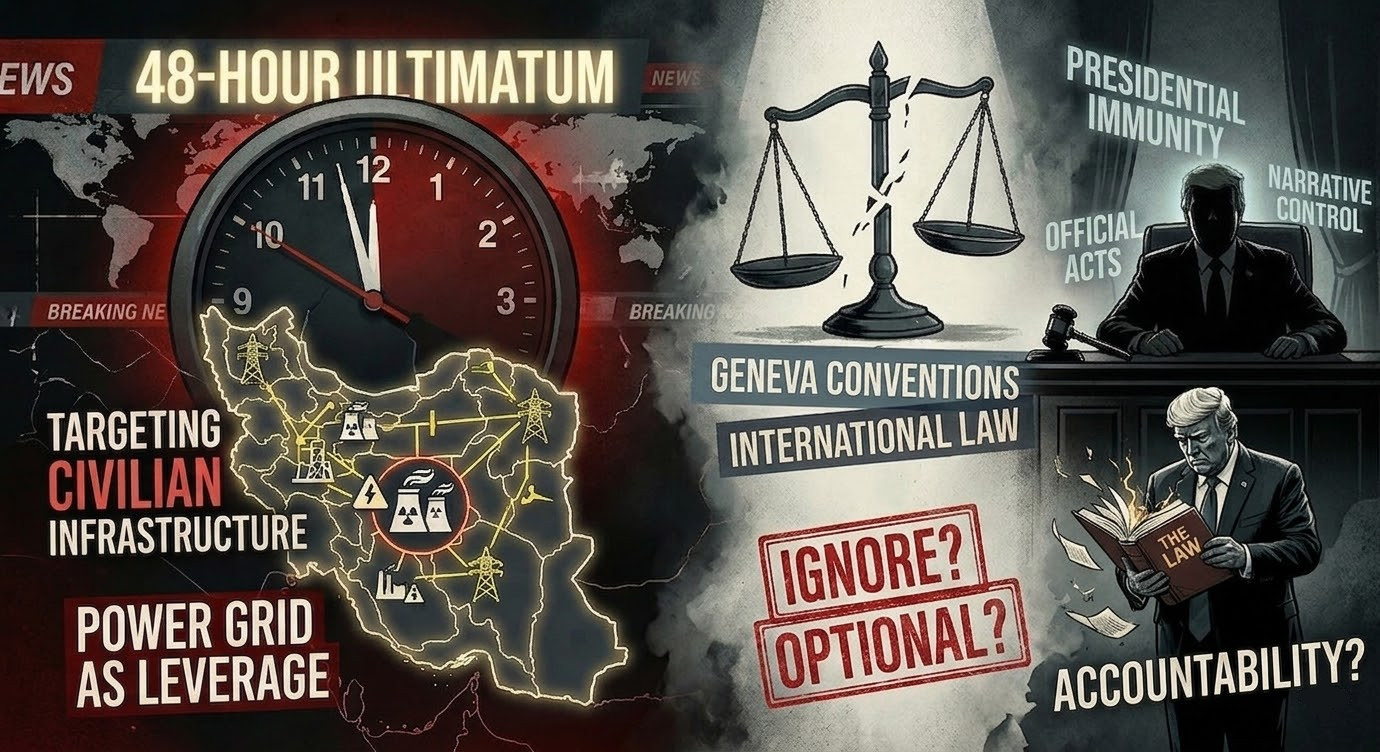
On Saturday, the world got a countdown:
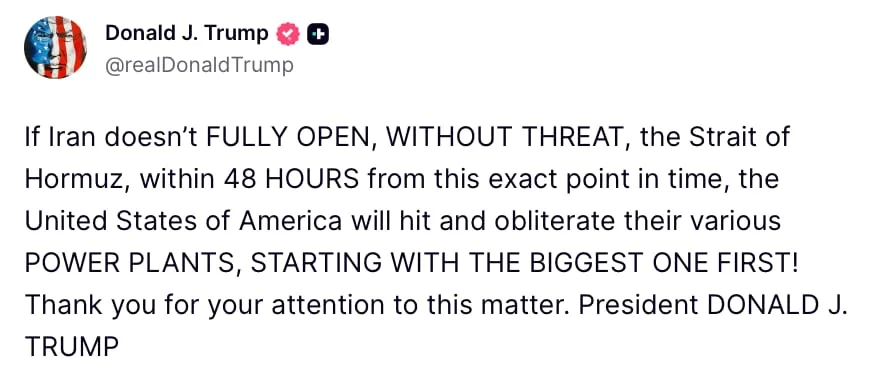
Open the Strait of Hormuz in 48 hours – or face the “obliteration” of Iran’s power grid.
“Starting with the biggest one first.”
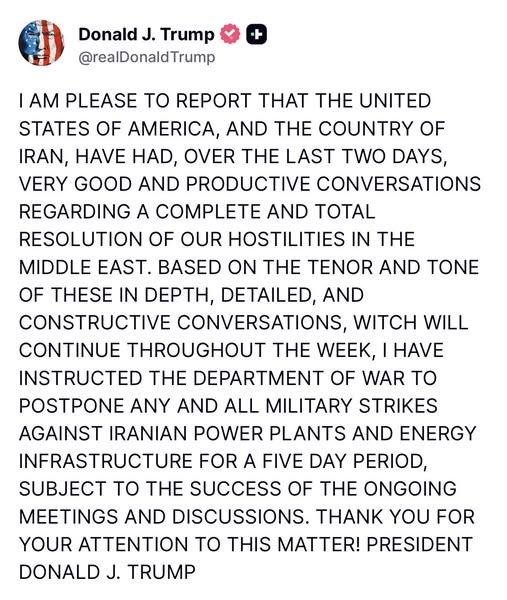
By Monday, March 23, 2026, that deadline shifted. A new post announced a five-day delay, citing “productive conversations.”
But here’s the problem:
Iran says those conversations never happened.
That contradiction isn’t a side note. It’s the story.
Because when the justification for delaying military strikes is disputed in real time by the other party, we’re no longer watching diplomacy.
We’re watching narrative control.
This Isn’t Strategy. It’s Illegal on Its Face.
Under the Geneva Conventions, you don’t get to target civilian infrastructure as leverage.
Power grids are not “just infrastructure.” They are survival systems:
- Hospitals
- Water supply
- Food preservation
Destroying them doesn’t weaken a government – it collapses civilian life.
That’s why the law is explicit:
You cannot attack what civilians need to survive.
No loopholes. No “unless it’s effective.” No “unless it works.”
So when a President publicly threatens to “obliterate” a nation’s electrical grid, that’s not brinkmanship.
That’s the normalization of a war crime as policy.
The Video Everyone Should Remember
There’s a reason a recent political ad hit so hard:
“You can’t follow illegal orders.”
That line wasn’t hypothetical. It was a warning.
Because history has already tested this defense – and rejected it.
“I was just following orders” doesn’t hold up in court.
“I gave the orders” doesn’t either.
And yet, here we are – watching the idea resurface in real time.
The Immunity Effect
This doesn’t exist in a vacuum.
It exists in the shadow of the Trump v. United States decision, where the Supreme Court of the United States expanded presidential immunity for “official acts.”
The intent may have been constitutional clarity.
The effect is something else entirely.
Because when you tell a President that large categories of conduct are shielded from prosecution, you don’t just protect the office.
You change the psychology of power inside it.
You create the conditions for this exact moment:
A belief – stated or not – that authority itself is a legal defense.
And that belief runs into a hard limit:
The Supreme Court of the United States can define the scope of domestic prosecution, as it did in Trump v. United States.
But it cannot rewrite international law.
It cannot strip jurisdiction from the International Criminal Court.
It cannot redefine what constitutes a war crime under the Geneva Conventions.
“Official” does not mean “legal.”
And it certainly does not mean “legal everywhere.”
This Pattern Didn’t Start Here
This isn’t an isolated incident. It’s part of a broader pattern where rules are treated as optional:
- Ignoring congressional authorization norms for military escalation
- Publicly pressuring institutions meant to remain independent
- Treating legal limits as negotiable – dismissing oversight, rulings, or constraints as political obstacles rather than binding law
Individually, each move can be debated.
Together, they point in one direction:
A governing philosophy where legality is flexible – and enforcement is unlikely.
The “Nixonian” Logic Is Back
Richard Nixon said it plainly:
“When the President does it, that means it is not illegal.”
That idea didn’t die. It just went quiet.
Now it’s back – modernized, digitized, and posted in real time.
The Pentagon’s current leadership has made the break from international law explicit. Secretary of War Pete Hegseth put it bluntly:
“We don’t fight with stupid rules of engagement… No more politically correct rules – just common sense, maximum lethality, and full authority for warfighters.”
In other words: rules protecting civilians? Optional. The Geneva Conventions? A nuisance. When legality is treated as an obstacle, the stage is set for war crimes to become policy.
And the Most Dangerous Part? It’s Being Treated as Normal
The headlines tracked the countdown.
The commentary debated strategy.
But the core question keeps getting skipped:
Is this legal?
Because if threatening civilian infrastructure becomes just another negotiating tactic, then the red lines established after World War II aren’t red lines anymore.
They’re suggestions.
The Cost of the Precedent
In response to the 48-hour ultimatum, Iran didn’t just retreat; they doubled down. Ebrahim Zolfaghari, spokesperson for Iran’s Khatam al-Anbiya Central Headquarters, stated plainly:
“If the United States attacks fuel or energy infrastructure in Iran, then… all energy infrastructure, information technology systems, and desalination facilities belonging to the United States and the regime in the region will be targeted.”
They further clarified that the Strait of Hormuz – the world’s most vital oil bottleneck – would be “completely closed” and would not reopen “until our destroyed power plants are rebuilt.”
This is the “all bets are off” moment. When the U.S. floats the idea of targeting civilian survival systems, it gives the adversary a green light to do the same. We aren’t just looking at a military escalation; we are looking at the potential collapse of the region’s ability to provide water and power to its people.
The Bottom Line
A five-day delay doesn’t undo what was said.
It confirms it.
The United States is now openly floating the destruction of civilian-critical infrastructure as leverage – and doing so in a way that suggests legality is optional, narrative is flexible, and accountability is uncertain.
If that framework holds, the risk isn’t just conflict with Iran.
It’s something bigger:
A world where power defines legality –
and not the other way around.
Related: Tehran’s Black Rain and Broken Futures: Why Oil Must Be a “No-Go Zone” in War
War: The Reality Behind the Rose-Colored Glasses
The “47-Year War”: Did the U.S. Actually Start It 73 Years Ago?
The Dirt is Speaking: From Cyrus the Great to the 2026 Fight for Human Rights
Davos 2026: Thank You World for Standing Up to the Bully
Related Me We Too posts:
Trump really does not understand Iran.
I don’t think Trump should have started the Iran War.
War should be a last resort – not first resort.
And Trump should not have ripped up the Iranian agreement in 2018.
Iranian people are some of the strongest people in the world #freeiran #iranrevolution #womenrights
A whole World War Three is about to happen but people are worried about who got what filler injected
It is ridiculous that Trump expects to be involved in who Iran chooses as their next leader.
Trump obviously does not care about democracy or freedom in Iran