

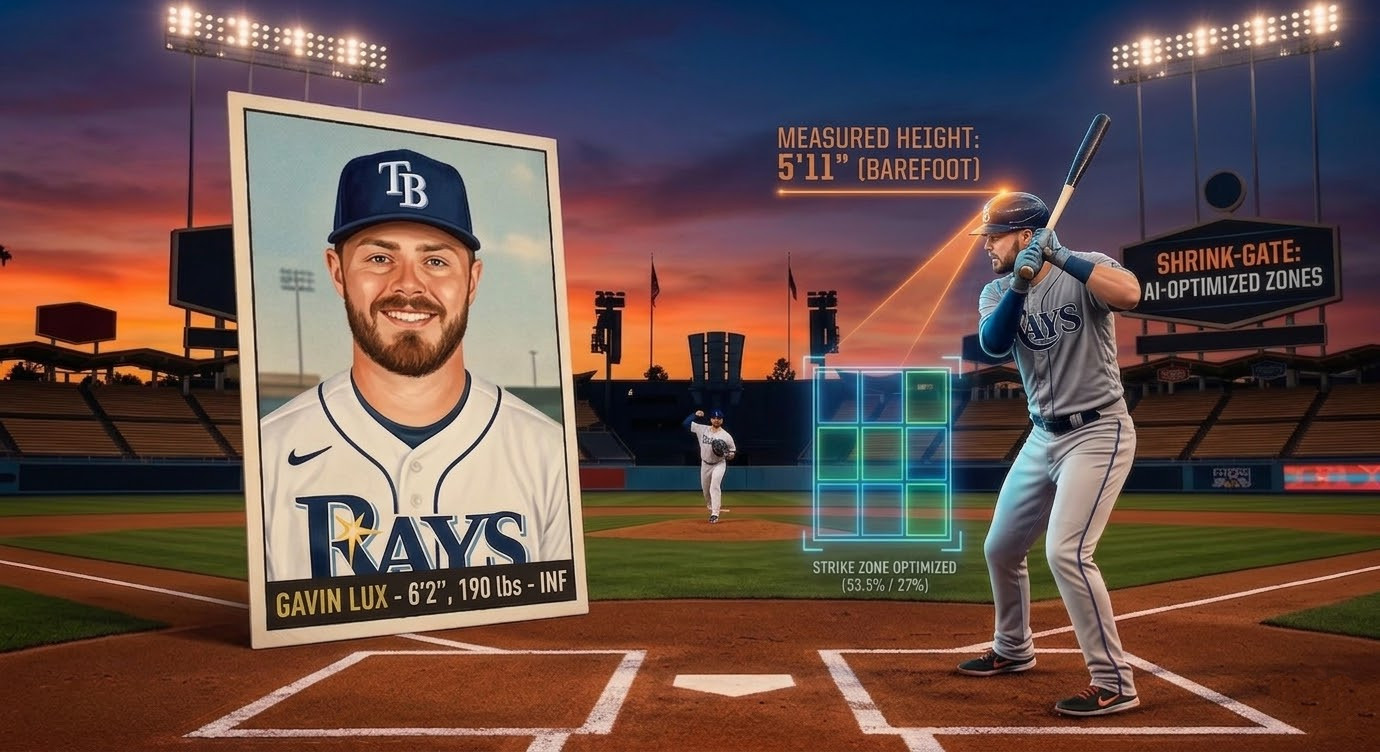
For a hundred years, the back of a baseball card was a sacred place for “optimistic truths.” It was part of the folklore of the game. We loved the idea of our heroes being these towering, powerhouse physical specimens – the kind of “larger than life” figures that belong on a pedestal. Whether it was rounding a height up to hit that magic 6-foot mark or shaving a few pounds off the scale to look like a “lean, mean, home-run machine,” the program was where the legend lived.
But those days are gone. The robots are here, and their first act of dominance wasn’t an explosive uprising – it was a bureaucratic adjustment.
Starting this season, MLB officially rolled out its Automated Ball-Strike (ABS) Challenge System. It’s not full-on “robot umpires” calling every pitch just yet; human umps still have the job, but teams now get two challenges per game where they can appeal a call to the “all-seeing eye” in the sky – a network of 12 high-speed Hawk-Eye tracking cameras. They keep their challenge if they are successful (similar to a tennis or volleyball challenge)
And this is where things get weird.
The Laser Truth
The AI sets a personalized strike zone for every hitter based on their vertical measurements. The top of the zone is calculated as exactly 53.5% of a player’s height, and the bottom is 27%.
This means that if MLB continued to use the “program heights” players had been self-reporting for decades, they’d be at a massive disadvantage. A guy who is actually 5’11” but listed as 6’1” would find his computerized strike zone was two inches higher than it should be, giving pitchers a target they haven’t earned.
To fix this, MLB skipped the “program heights” and went straight to the ultimate truth-teller: Barefoot Standardized Measurements.
During Spring Training, players were measured between 10:00 a.m. and noon (the league even accounts for the scientific fact that you are tallest in the morning!). They stood barefoot, heel to wall, head straight. A laser measured them, and a computer certified the number.
The results? A clubhouse epidemic of sudden, mysterious shrinkage.
The Victims of Shrink-Gate
The internet noticed immediately when official rosters were updated this month. The physical landscape of the league appeared to have changed over the winter. Elite athletes had seemingly contracted.
The poster boy for Shrink-Gate is Gavin Lux of the Rays. Last season, he was an imposing 6-foot-2 infielder. This year, the computerized laser certified him at… 5-foot-11. That is three full inches. One minute you’re a towering presence on the roster; the next, the data reveals you’re actually a slightly more compact, high-performance athlete.
But Lux wasn’t alone. The measurement epidemic was widespread:
- Bo Naylor dropped three inches, from 6’0″ to 5’9″.
- Connor Wong dropped two inches, from 6’1″ to 5’11”.
- Even the superstars weren’t safe. The Phillies’ Bryce Harper, who has been listed as high as 6’3″ in the past, was measured at a sleek, honest 6’1″.
The Surprise ‘Growth’
Strangely, the opposite happened to the truly enormous men of baseball. Those players who are so tall they might habitually slouch in photos actually “grew” when forced to stand up straight against a laser.
The Baltimore Orioles’ closing pitcher, Felix Bautista, had always been listed as 6’5”. The AI laser set him straight: He is actually 6-foot-8. He gained three inches purely because the league stopped letting him slouch. We also saw Shohei Ohtani and Julio Rodriguez both officially grow an inch to a towering 6-foot-4.
Why Honesty is the New Meta
In the era of the “human element,” having a slightly larger-than-life profile in the program might give you a mental edge. But in the era of AI and standardized zones, accuracy is the ultimate advantage – the winner in the Most Effective Tactics Available (META).
If you are 5’11”, you want the computer to know it. You need that strike zone box as small as possible to force the pitcher to come to you. The era of the charming baseball lie is over. It’s been replaced by 12 cameras, a private 5G network, and a laser that does not care about the “legend” on the back of your card.
Welcome to the future. Stay humble, stand straight.
Related Me We Too polls:
Baseball is the best sport to watch. The anticipation keeps me on edge. Love it
Baseball can be pretty boring to watch
I’m obsessed with fantasy Baseball and play auctions daily during Spring Training
I play fantasy baseball at work
Am I the only one that doesn’t understand all the fuss about baseball?
I am amazed at what AI can do these days, but it also scares me a little.







Era of “optimistic truths” is over. 📉 MLB’s robot umps just called everyone’s bluff with laser-measured reality.
From Gavin Lux “shrinking” 3″ to Felix Bautista “growing” to 6’8″, the 2026 strike zone has changed the game. 🤖⚾️
azipurl.app/shrinkgate
#MLB #ShrinkGate #RobotUmps #RaysUp #GavinLux