

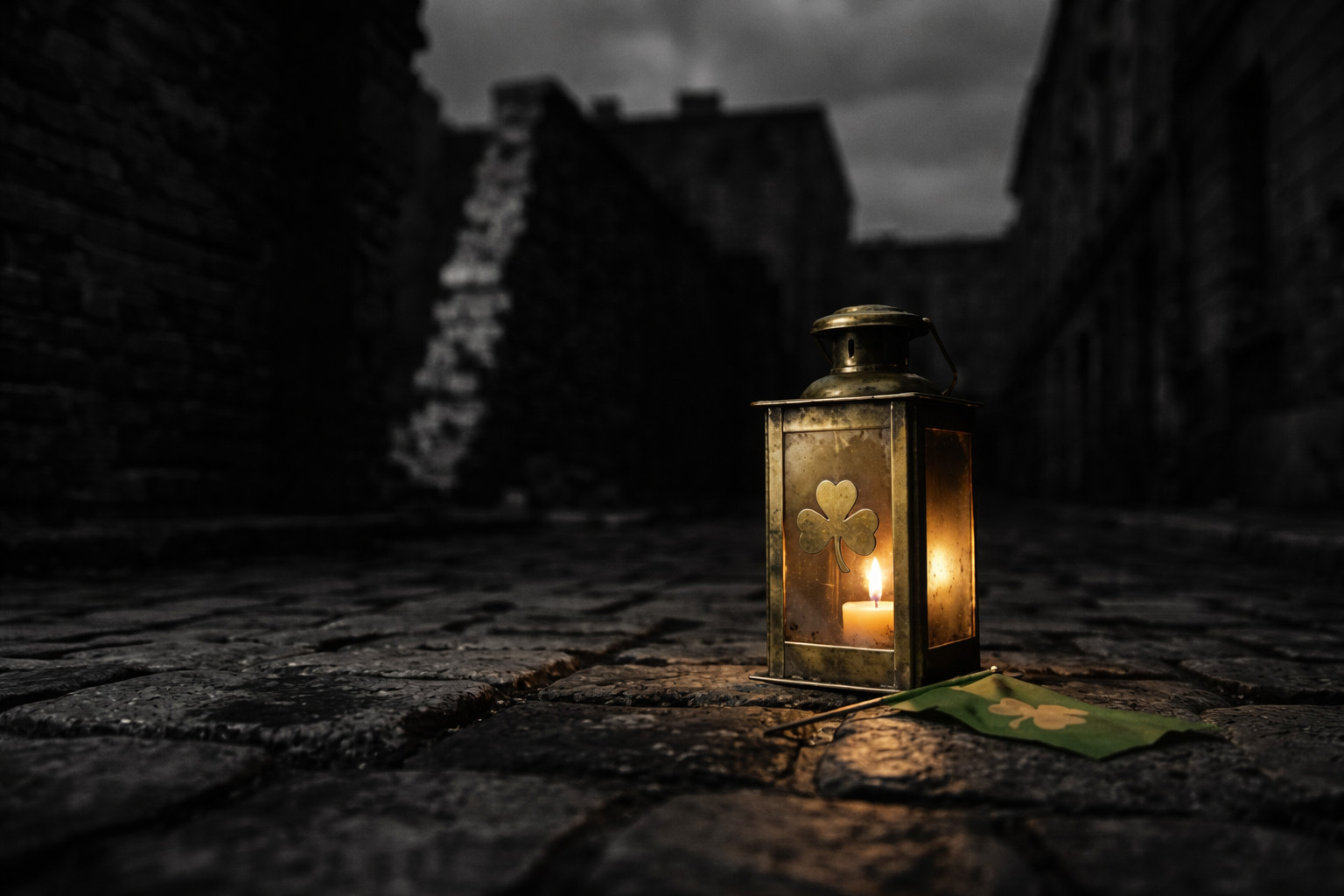
The history of the Holocaust is often told through numbers – six million dead, 1.5 million of them children. But numbers are easy to deny, and statistics are easy to ignore. One antidote to erasure is the story of the Dom Sierot (Orphans’ Home) at 92 Krochmalna Street in Warsaw.
This is the story of two people who built a world of light inside a kingdom of ash. Their final walk remains the ultimate indictment of any ideology – past or present – that treats human beings as “disposable.”
The Architects of the “Children’s Republic”
Janusz Korczak and Stefania “Stefa” Wilczyńska were already known figures long before the darkness fell. Korczak, the beloved “Old Doctor,” had reshaped how the inner lives of children were understood through his writing.
Wilczyńska is harder to place in most retellings, though she shouldn’t be. She was the one holding the system together when it began to fray. The day-to-day structure. The continuity that doesn’t announce itself but keeps everything from collapsing.
Together, they didn’t just run an orphanage. They called it a “Children’s Republic” – and it functioned like one.
Inside it, the children managed their own lives through a Judicial Council. This wasn’t a game; it functioned as a legal system with its own code of laws. Every week, a court was held where children served as the judges and the jury. They heard cases brought by children against other children, and, crucially, cases brought by children against their teachers – including Korczak himself.
Even in the ghetto, even while starving, they kept the court sessions running. Children brought complaints, and the adults were required to submit to the verdict of the child-judges. It wasn’t symbolic. It was a stubborn insistence that dignity and the rule of law do not disappear just because the world outside has descended into chaos.
The Trap Closes
When the Nazis invaded in 1939, “othering” stopped being only language. It became structure. Wilczyńska was in Palestine at the time – safe. She chose to return. She walked directly into a war zone to be with her children.
By 1940, they were inside the Warsaw Ghetto. The walls altered everything – time, food, even the tone of voice. Typhus moved through the rooms. Hunger became constant background noise. Korczak weakened visibly. Wilczyńska kept the impossible logistics together for 200 children. A number that stops being abstract once you sit with it.
August 5, 1942: The Final Procession
When the “liquidation” began – an ugly, clinical word the Nazis used to describe the mass clearing of the ghetto for the gas chambers – the Polish underground offered Korczak a way out. Forged papers. A hiding place.
He refused. It wasn’t a dramatic gesture; it was a decision already settled before the question arrived.
The children were told they were going on a trip to the countryside. They were dressed in their best and cleanest clothes. They lined up in ranks of four.
Korczak led the way, holding the hands of the two youngest children. Wilczyńska followed with the rest, a steady presence at the back, ensuring no one faltered. The procession stretched for nearly two miles. At the front, a child carried the Green Flag of the Republic – a gold clover on a field of green.
People watched them pass. Most looked away. That silence was the fuel for the cattle cars. At the train tracks, an officer gave Korczak one last chance to step aside. He didn’t answer. He shook his head and stepped into the car with Wilczyńska and the children.
The Treblinka Reality
They were taken to Treblinka, an extermination center built solely for killing. It was a place designed for deception; the gas chambers were built to look like communal showers.
Before entering, the children were forced to undress so the state could seize their clothes and shoes – the final act of theft in a system that viewed human beings as a resource to be harvested. Even in this room, standing vulnerable and stripped of everything, Korczak and Wilczyńska remained with them.
While no one survived to recount their final moments, we know how they lived. It is widely believed that through the sweltering hours in the cattle cars and the final moments in the “showers,” Korczak and Wilczyńska continued to do what they had done for decades: they told stories. They maintained the “Children’s Republic” until the air ran out. It matters that their names are spoken together, because that is how they remained in the end. No separation. No final break.
The Echoes in 2026
We like to think the floor of civilization is solid. It isn’t. And in 2026, the cracks are widening.
The foundation for this was laid years ago when Donald Trump turned the “othering” of neighbors into a platform for power. When he claims that immigrants are “poisoning the blood of our country,” or characterizes refugees as an invading force of “murderers” and “animals,” these are not just political phrases. He tested the limits of this when he spread the debunked, racist fantasy that Haitian immigrants were “eating the dogs… eating the cats” of their neighbors.
The most haunting part of the 2026 reality is not just that he said these things, but that he was still elected. This proved that a significant portion of the electorate was willing to look right past the dehumanization of their neighbors in exchange for the transactional hope of lower prices. It reveals a society where integrity was traded for personal gain, and where the suffering of “the other” was considered an acceptable price to pay for a perceived economic advantage.
But this national rhetoric is only half of the tragedy. The other half is the “Grammar of Silence” that has taken root in our response to it. We see this in the aftermath of October 7, the deadliest massacre of Jewish people since the Holocaust. In the face of such horror, there was a profound current of moral clarity – people who stood in the light, offering immediate, unwavering condemnation and solidarity. But that clarity was not universal. Instead, the response revealed a society fractured at its core. While many met the tragedy with a hauntingly familiar silence, a vocal minority met it with an active, public celebration of the “other’s” pain.
When leaders – from local city halls to international stages – met the horror with calculated delays or shielded those who celebrated the violence as a “private” matter, they helped normalize a world where a victim’s humanity is stripped away before their blood is even dry.
This environment of indifference is the dark oxygen that allows the machinery of 2026 to function. With the passage of the “One Big Beautiful Bill” in July 2025, the government secured over $170 billion to transform these ideas into execution. ICE has been aggressively empowered, doubling its ranks and launching “Operation Metro Surge” raids in major cities. While lower courts have ruled the use of the Alien Enemies Act unlawful, the administration has consistently bypassed these orders, moving deportees on flights before the law can intervene. It is a structural shift that treats residents as enemies of the state rather than human beings with rights.
This chilling ideology of state-mandated “re-sorting” was echoed by the Secretary of Health, Robert F. Kennedy Jr. as well in a 19Keys podcast. During his presidential campaign in 2024, Kennedy claimed that “every Black kid is now just standard put on Adderall, on SSRIs, benzos, which are known to induce violence,” and suggested that “those kids are going to have a chance to go somewhere and get re-parented – to live in a community where there’ll be no cellphones, no screens.”
While the historical scale differs, the presumption of state power remains strikingly familiar: it is the claim that a government holds a superior right to define which families are legitimate and which children are “disposable.” “Never Again” begins to fail the moment we accept the idea that the state has the right to dismantle the sanctity of a family based on its own ideological definitions.
The Commitment to Act
The legacy of Janusz Korczak and Stefa Wilczyńska is not just a memory; it is the backbone of international law. In 1978, to mark the hundredth anniversary of Korczak’s birth, the Polish government proposed a global treaty based on his revolutionary work. This became the 1989 UN Convention on the Rights of the Child, the most widely ratified human rights treaty in history.
Korczak is officially recognized as the spiritual architect of this document and is often called the “Father of Children’s Rights.” When Korczak famously wrote, ‘Children are not people-to-be, they are people,’ he was providing the DNA for the treaty that now governs how the world is supposed to treat its most vulnerable. But the rights he advocated for – the right to participation, dignity, and respect – were proven possible by Stefa Wilczyńska’s tireless devotion.
The UN acknowledges that their work transformed children from “property” into sovereign human beings with their own legal standing. It established three non-negotiable standards that directly mirror the “Children’s Republic”:
- The Right to Protection: Shielding children from all forms of violence, neglect, and state-mandated cruelty.
- The Right to Participation: Ensuring children have a voice in the matters that affect them – a direct legacy of the Weekly Court.
- The Best Interests of the Child: Establishing that a child’s welfare must be the primary consideration in every state action, overriding political or economic agendas.
Holocaust denial starts with oversimplification and ends with “othering.” We remember the children of the Dom Sierot because forgetting is easier than confronting what systems do when no one interrupts them. When nationalism becomes loud enough to sound like certainty, it is already asking for silence from someone else.
In the wake of this week’s Holocaust Remembrance ceremonies, we are reminded that “Never Again” is not a prayer, but a commitment to act.
Related: The Grammar of Silence: Mayor Mamdani and the “Private” Language of City Hall
The Blueprint for a Registry: How the “Penn List” is a Threat to Every Minority in America
Power, Language, and the Dehumanization of the “Other”
Related Me We Too polls:
Hate speech should be condemned.
They really shouldn’t be minimizing war and the mass casualties with phrases like “mowing the lawn”
Not surprised anymore when Trump says phrases like “blown the shit out” … and “fuck” – so vulgar
I didn’t think Trump would apologize for posting the racist meme video of the Obamas (and he didn’t)
It is crazy that the Trump admin & EEOC is suing Penn to get a list of Jewish students and staff.







6M murdered. 1.5M children. History is made one choice at a time.
Janusz Korczak and Stefa Wilczyńska built a “Children’s Republic” in Warsaw and walked with their children to the end.
What we tolerate now→what comes next.
🔗 azipurl.app/never-again
#HolocaustRemembrance #NeverAgain #HumanRights