When we think of the “24-hour news cycle,” we think of it as a modern given. But before 1980, the idea of a round-the-clock news channel was considered a fool’s errand. It took a man often called “Terrible Ted” or the “Mouth of the South” to prove the world wrong.
Ted Turner passed away on Wednesday, May 6, 2026, at the age of 87 at his estate east of Tallahassee in Lamont, Florida. He died peacefully, surrounded by family, following an eight-year battle with Lewy Body Dementia. He is survived by his five children – Laura, Teddy, Rhett, Beau, and Jennie – along with 14 grandchildren and two great-grandchildren. Despite his massive success, he remained a man of the people, famously telling anyone who addressed him as “Mr. Turner” to simply: “Call me Ted!”
The Billboard King: A Legacy Born of Tragedy
Ted didn’t start in a boardroom; he started in the mud of the billboard business. In 1963, at just 24 years old, Ted’s world was upended when his father, Ed Turner, despondent over financial struggles, took his own life. Ted was thrust into the presidency of Turner Outdoor Advertising, a company drowning in debt. Out of a sense of profound duty, he threw himself into the work with a ferocious intensity, building it into the largest billboard firm in the Southeast and providing the money maker for his future media empire.
The Origins of “Terrible Ted” and the “Mouth of the South”
Turner didn’t just enter a room; he shook it. He earned the nickname “The Mouth of the South” for his loud, unfiltered personality and his tendency to shoot from the hip. As for “Terrible Ted” (also sometimes called “Captain Outrageous”), that came from his reputation as a relentless competitor in professional sailing. In 1977, after winning the America’s Cup, he famously showed up to the press conference visibly intoxicated, swigging rum and falling off his chair. The media branded him “Terrible Ted,” a name that stuck as he bullied his way into the cable television industry.
The Man Who Invented the Future of News
In 1976, Ted pioneered the “Superstation” concept by turning a small Atlanta station into WTBS, beaming it nationwide via satellite. Then came CNN in 1980. Though experts dubbed it the “Chicken Noodle Network,” Turner saw that people wanted news when it happened. His impact was so great that in 1991, Time Magazine named him “Man of the Year” for turning viewers in 150 countries into “instant witnesses of history.”
To ensure CNN felt truly global, he famously banned the word “foreign” from the airwaves, instituting a $50 fine for anyone caught using it – a penalty he eventually doubled because he believed the world was too small for borders. Staffers from the early days recall that after paying a few fines, everyone quickly learned to say “international” instead.
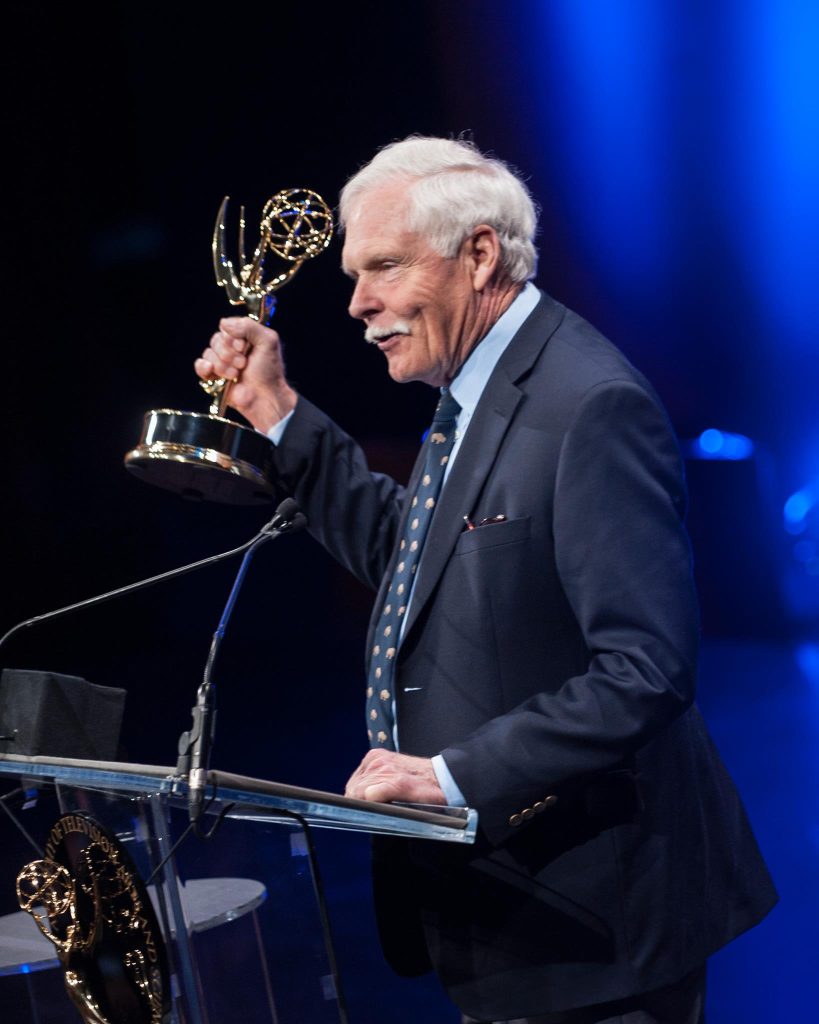
The industry eventually honored his journalistic impact with a Lifetime Achievement Award at the 2015 News and Documentary Emmys. But Ted’s commitment went beyond awards; he famously promised at CNN’s launch that the network would not sign off until the world ended. To back that up, he prepared a “Doomsday Video” – a recording of a military band playing “Nearer, My God, to Thee” – to be played as the network’s final broadcast.
This was his pledge of total availability. CNN fulfilled that mission of “always being there” in 1991 during the Gulf War. While other networks relied on taped reports, CNN was the first to broadcast a war in real-time, bringing live anti-aircraft tracers into living rooms across 150 countries and permanently changing how the world witnessed conflict.
Women in the News: The “Jane Fonda” Case Closed
Ted’s approach to hiring was as legendary as his broadcasts. In the late 1970s, as he was first assembling the “CNN Originals,” he met with Denise LeClair Cobb and, in his typical unfiltered fashion, blurted out: “Wait a minute… they didn’t tell me you were a woman! I didn’t ask for a woman!” However, once he saw her grit, he became her most fierce advocate. Years later, in the early 1990s, when the legendary Judy Woodruff asked him during a recruitment meeting how he felt about women in the news, Ted pushed back with a classic line: “Are you kidding? I’m married to Jane Fonda!” To Ted, that was “case closed,” and he went on to champion many of the most influential women in the history of broadcast journalism.
Life at the Office: The Nightrobe and Coffee
For years, Ted literally lived the job. His residence was a modest penthouse located directly above his CNN office in Atlanta. Staffers fondly remember working late into the night and seeing Ted wander down into the newsroom wearing a nightrobe, carrying a cup of coffee to check on the latest headlines. During his marriage to Jane Fonda, it wasn’t uncommon for her to join him, also in her pajamas, sometimes even bringing down freshly baked cookies for the overnight crew. This “family business” atmosphere defined the early, gritty days of the network.
The MGM Library and the Colorization Controversy
Turner was a master of content. His 1986 purchase of the MGM film library provided the “fuel” for TNT, TCM, and Cartoon Network. However, it wasn’t without drama. In the 80s, he infuriated film purists by colorizing classic films like Casablanca. Turner gave a characteristically blunt response: “The last time I checked, I owned those films. I can do anything I want with them.”
A Billion-Dollar Bet on Humanity
In 1997, Ted made a historic $1 billion donation to the United Nations. Over his lifetime, his total giving exceeded $1.3 billion. He co-founded the Goodwill Games in 1986 with the audacious goal of helping bridge the divide of the Cold War. He believed that through “sports, news, and friendship,” he could save the world. He lived by the mantra: “Lead, follow, or get out of the way.”
High-Profile Life and the “Captain Planet” of Real Life
Turner was married three times, most famously to actress Jane Fonda (1991–2001). Beyond Hollywood, Turner is credited with becoming the leading private force in saving the American bison from the brink of extinction, managing a herd of 45,000 on his massive ranches in Montana and across the West. He even brought this mission to TV as the mastermind behind the animated series Captain Planet and the Planeteers.
The Man Who Never Knew How to Quit
Turner’s life wasn’t without its lows. He called the AOL-Time Warner merger in 2000 the “biggest mistake” of his life.
Yet, the fire remained. In a high-profile interview he did with CBS Sunday Morning in 2018 (his first big interview after revealing his Lewy Body Dementia diagnosis), when Ted Koppel asked him about his drive and if he was finally slowing down, he explained his relentless drive with a simple truth:
“I can’t quit. I just don’t have it in me. I’m a fighter. I’m a scrapper.”
It was a deeply moving moment because, even as he was struggling with memory and speech due to the dementia, that core “Ted” fire was still there. He was basically saying that even though his brain was failing him, his spirit didn’t know how to give up.
This refusal to stay down was his defining trait. He turned the Atlanta Braves into “America’s Team,” and in 1977, he famously tried to manage the team himself for a single game – a loss against the Pirates. He was immediately banned by Commissioner Bowie Kuhn, who told him: “If you’re smart enough to make $100 million, you ought to be smart enough to know you can’t manage a baseball team.” Despite the ban, his visionary leadership in sports was eventually honored with a Lifetime Achievement Sports Emmy in 2014 – strikingly, on the same calendar date he would pass away twelve years later.
Ted Turner didn’t just participate in history; he steered it. He once joked that his tombstone should read: “I have nothing more to say.” But through his networks, his philanthropy, and his bison, his voice will be heard for generations to come.